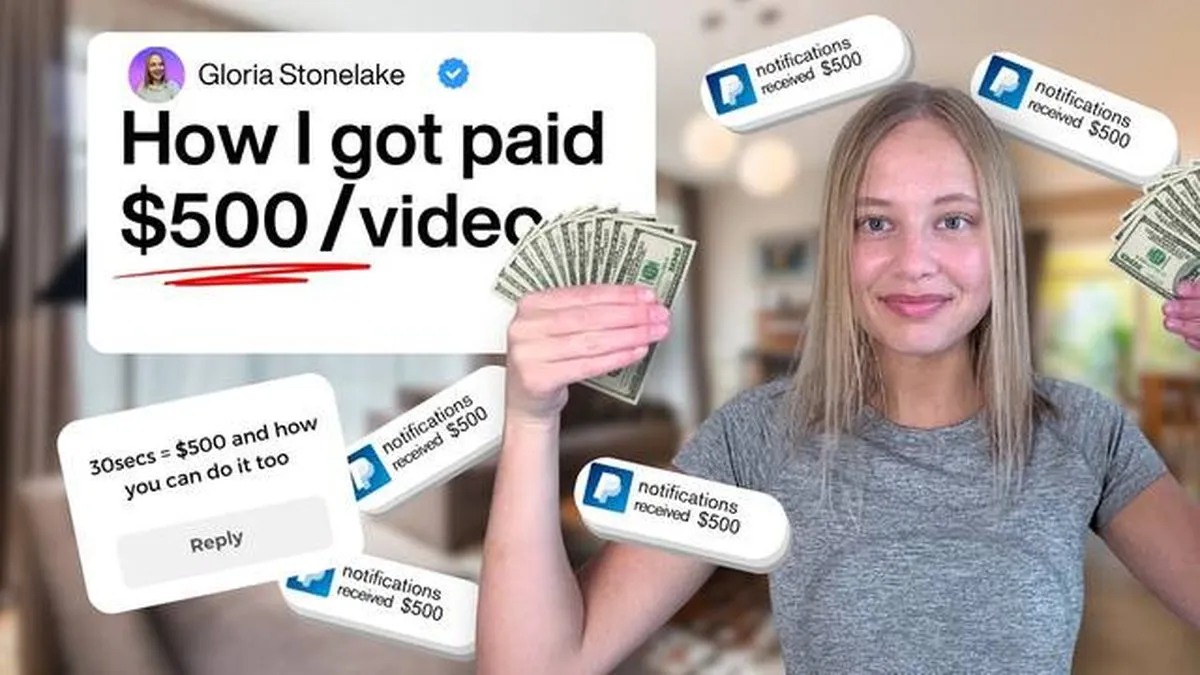
UGC Usage Rights: How I Got Paid Twice for One $300 Video
Key takeaways
- UGC usage rights are separate from the fee to film a video: one covers making it, the other covers the brand running it as a paid ad, and for how long.
- Start every deal with 30 days of paid usage on one platform, and price any extension by time and platform.
- Ask every brand "Will this be used as paid advertising or whitelisting?" before you send a number.
- Gloria turned a $300 skincare test ad into $700 by invoicing 180 days of extended usage, and Maya Herring negotiated a $6,000 perpetual buyout on one video by email.
- Turn down whitelisting deals for products you do not believe in, because the brand is borrowing your audience's trust.
Six months after I filmed a $300 test ad for a skincare brand, their email landed in my inbox. The ad was performing well, and they wanted to keep running it for another 180 days.
It had been a small job. They wanted one short video for testing, I delivered it, they liked it, and I thought I was done.
Most creators would say yes to that email and move on. I had a price ready for exactly this moment, based on how long the brand wanted to run the video and which platforms it would run on. So I invoiced them for extended usage rights.
That one email turned my $300 project into a $700 one. No extra filming, no extra work.
Gloria Stonelake, 0:02:31
The extra $400 came from treating the right to run my video as its own product, with its own price. That right is called UGC usage rights, and it is the most slept-on upsell in this business.
What are UGC usage rights?
UGC usage rights are the permission a brand buys to run your video, spelled out by where it runs and for how long. User generated content (UGC) is the short, real-person video a brand pays you to film, and the right to run it is a separate thing from the filming.
Every brand deal has two parts you can charge for. The first is making the video: your time, the filming, the editing. Usage is the second part: the right for the brand to run that video as a paid ad, plus how long they get to do it.
Beginners charge for the first part and hand over the second part for free. I wrote this to my community in July 2026:
what you charged to film it has nothing to do with what it's worth once it's a working ad.
Gloria Stonelake, Skool post, 2026-07-09
A few terms will show up in brand emails, and you should know them before you reply:
- Paid usage (licensing): the brand puts ad budget behind your video and runs it as an ad, under a time-limited license.
- Whitelisting: the brand runs ads from your personal account instead of its own, because a real creator's account adds credibility a corporate page can't match.
- Perpetual usage: the brand can run the video forever with no window to renew, also called a lifetime buyout.
Maya Herring, a creator in our community, remembers having to look all of this up when she started.
What does perpetually mean or what does paid usage mean? What's the difference between whitelisting and ad use
Maya Herring, UGC World interview, 0:11:52
Why does a brand pay more to keep running your video?
A brand pays more because a video running as an ad is earning them money for as long as it stays live. Once your video goes into their ads, your face, your voice and your creative direction become the brand to its potential customers.
At that point, they're not just buying content. They've rented your performance.
Gloria Stonelake, YouTube video of 2025-06-17, 0:01:33
Inside my community I call this the face tax. When your video runs as paid ads, you are their spokesperson to thousands of people, and that deserves its own price.
The brand's side of the math matters too. When a winning ad is still running at the end of your usage window, they have two choices: pay you to extend, or shut off an ad that is making them money. Killing a winner hurts them more than paying you does, which is why performing ads get extended.
What is the default usage window for UGC?
Start every deal with 30 days of paid usage on one platform. That is my default, and anything beyond it gets quoted separately.
You should never include unlimited usage in your base rate. You start with 30 days, one platform, that's it.
Gloria Stonelake, 0:05:04
Picture the skincare deal with unlimited usage baked in. The email six months later would have been worth nothing to me, because there would be nothing left to extend and nothing left to invoice.
Your upsell moment is the email where the brand says, "Hey, this is working. Can we keep running it?" With a 30-day window in place, that email turns into a second payday.
If you are still working out what to charge for the video itself, start with how much to charge for UGC, then add usage on top of that number.
How do you price UGC usage rights?
Price usage by two things: time and platform. The longer the brand wants to run your video, and the more platforms they want it on, the more they pay.
Licensing fees can be set monthly, quarterly or yearly. These are numbers from my own deals, so you can see real figures instead of guesses:
- Face in paid ads: $200 to $500 extra, depending on the brand's budget and reach, so a supplement brand with serious ad spend pays more than a local business.
- Whitelisting: $150 to $300 a month per active campaign, and one video I made four months before writing that down was still paying me monthly.
- Extended usage: $400 on top of the original $300 for the skincare test ad, for 180 more days.
Some creators charge $100 to $500 a month per platform, depending on what they deliver and how widely the brand runs it.
My best-performing video from last year earned over $2,800 in total. That broke down to $500 for the original video, $300 in usage rights, a $200 performance bonus and $1,800 in recycled versions across platforms.
When a repeat client asks about full rights, I anchor the price first.
Normally, brands pay me $2,000 for full commercial rights, but since you're a repeat client, I can do it for X amount or $1,000.
Gloria Stonelake, 0:03:31
Next to $2,000, the $1,000 feels like a good deal to the brand, and my deal still gets bigger. For the wording around pushback, read how to negotiate UGC rates without apologizing.
Write your usage prices down before a brand ever asks. The skincare email turned into $400 because the price already existed when it arrived.
What should you ask a brand before you quote a UGC rate?
Before you send any number, ask the brand whether the video will run as an ad. I put it to them in these exact words:
Will this be used as paid advertising or whitelisting?
Gloria Stonelake, YouTube video of 2025-06-17, 0:02:03
A yes means your usage terms go in writing. Start with a 30-day usage window, and if they want to extend, that becomes another check.
Then put the split right into your proposal. I use one line:
this covers creation plus 30 days of paid usage. usage beyond that is quoted separately.
Gloria Stonelake, Skool post, 2026-07-09
That line does two jobs. It tells the brand that running your content long-term costs extra, and it opens the door to charge again with zero new filming. For everything else that belongs in the paperwork, read what to check before you sign a UGC contract.
Plenty of creators skip the question because they are scared to lose the deal. Brands that run ads already know what usage is worth, and when you bring it up with confidence, they respect you more for it.
What is perpetual usage, and when should you sell it?
Perpetual usage means the brand can run your video forever, with no window to renew. You give up every future extension, so a perpetual buyout should be priced far above a 30-day license.
Maya Herring learned what that is worth on a video she made for a multi-million dollar brand. Less than a year after she filmed it, the brand came back with an offer to buy perpetual usage. The video had done big numbers and conversions when they first ran it, and buying the usage up front meant they would not have to deal with the legal side later.
Their first offer was already high. Maya pushed for more anyway, and she did it entirely by email, because the brand team was too busy to get on a call.
So initially the number was already high but I just wanted to go higher.
Maya Herring, UGC World interview, 0:54:20
In her reply she thanked them, then explained what the usage would mean for her, knowing the video was doing a lot of numbers for their business. Her framing was simple: this is a big number, but it's an investment. The brand came back with a final offer a little under her ask, and she took it: $6,000 for lifetime usage on one video.
It's not the number of what they paid for the usage. It was just me knowing that the video performed so well that they were willing to pay for a lifetime of usage on it.
Maya Herring, UGC World interview, 0:53:48
What Maya did right, in a list you can copy:
- Know the buyer: she knew a multi-million dollar brand had usage budget for a video like hers.
- Point to results: her email tied the ask to what the video was doing for their business.
- Use email when a call is off the table: the whole negotiation happened in writing.
- Take a fair final offer: their final number came in a little under her ask, she was fine with it, and she closed.
When should you bring up usage with a brand?
Bring up usage at the moments the brand already sees value: when you deliver, when the video gets a good response, and when the usage window ends. You are guiding them to invest more in something that is already working.
At delivery, the brand is happy and holding new content, so I plant the seed with one line.
By the way, if you want to use this for ads, I can license you full usage rights.
Gloria Stonelake, 0:03:01
Sometimes I post the video on my own page and tag the brand. Once the comments and feedback come in, the next line is easy: their audience is responding well, and I can license the footage for paid ads if they want to scale it.
When the window ends and the ad is still live, a short note does the rest.
your video's still live, want to extend usage for the next window?
Gloria Stonelake, Skool post, 2026-07-09
You already made the video. In my words to the community, this is money for a sentence.
Usage is one of several add-ons I stack on a deal, alongside B-roll packages, raw footage, extra hooks and extra calls to action. I walk through each one in how I turn one $300 deal into more. When a brand keeps extending month after month, that relationship is ready for the conversation in how I turn one-off deals into a monthly UGC retainer.
When does a paid-usage deal cost more than it pays?
A paid-usage deal costs more than it pays when the brand wants to borrow trust you are not willing to spend. I learned this with a $4,000 offer I turned down.
A brand emailed me offering $4,000 for a 90-second video promoting a women's fertility tracking app. I had never used it, did not believe in it, and frankly thought it was scammy. My brain fought me hard, because $4,000 is a month of rent and groceries and savings in a single email.
What made this deal different was the usage. The brand planned to run the video whitelisted on my account, where my actual community lives. Anyone watching it would be one of the same girls in my DMs every day asking for advice, and if I told them the app was good, they would buy it and remember who recommended it.
the $4,000 was real. so was the trust I'd be cashing in to take the money.
Gloria Stonelake, Skool post, 2026-06-25
Most creators judge a deal like this in isolation and ask whether $4,000 is worth 90 seconds of filming. The better question is whether it is worth the long-term cost of recommending something you do not believe in to the people who trust you.
I said no. Here is the exact email I sent back:
I appreciate the opportunity, but this product isn't a fit for my audience. happy to recommend a few other creators who might be a better match.
Gloria Stonelake, Skool post, 2026-06-25
Then I gave them the names of three other creators. Before you agree to any whitelisting deal, run two checks:
- Do I believe in this product enough to put my own account behind it?
- Would I be comfortable if my followers bought it because I said so?
Put the usage line in your next proposal
You do not need a new client to try this. Open your next proposal and add the line that separates creation from usage: creation plus 30 days of paid usage, with anything beyond that quoted separately.
My skincare video earned a second payment because the price for an extension existed before the brand ever came back. I filmed nothing new, and the only new thing was an invoice.
The figures in this post are what I and Maya Herring were paid on specific deals. They show what happened for us on those projects, and your own rates depend on your work, your clients and your effort. Nothing here promises a result.
Frequently asked questions
What are usage rights in UGC?
Usage rights are the permission a brand buys to run your video, defined by where it runs and for how long. They are separate from the fee for filming it. Gloria starts every deal with 30 days of paid usage on one platform and quotes anything longer separately.
What is the difference between usage rights and whitelisting?
Paid usage lets the brand run your video as an ad from its own accounts. Whitelisting means the brand runs ads from your personal account, because a real creator's account carries credibility a company page lacks. Gloria has charged $150 to $300 a month per active whitelisting campaign.
What does perpetual usage mean in UGC?
Perpetual usage means the brand can run the video forever, with no window to renew. You give up every future extension, so it should cost far more than a 30-day license. Maya Herring negotiated a $6,000 lifetime usage buyout on a single video, entirely by email.
Should UGC creators include unlimited usage in their rate?
Gloria's answer is no. Unlimited usage in your base rate leaves nothing to extend later, so a winning ad never turns into a second payment. Keep the base rate to creation plus 30 days on one platform.
How much should I charge for UGC usage rights?
Price usage by time and platform: the longer the run and the more platforms, the higher the fee. From her own deals, Gloria has charged $200 to $500 extra when a brand puts her face in paid ads, and she invoiced an extra $400 to extend one test ad for 180 days.
About the author. Gloria Stonelake is co-founder of UGC World and Head of Creator Talent. She took home over $150K in one year from UGC, then built the agency brands pay to staff their campaigns with trained creators. Meet the UGC World team.
UGC World is a personal and business finance education and training company. Results described here are the experiences of the named creators and are not typical. Success depends on implementation and effort. We do not make claims about what you should expect to make.

