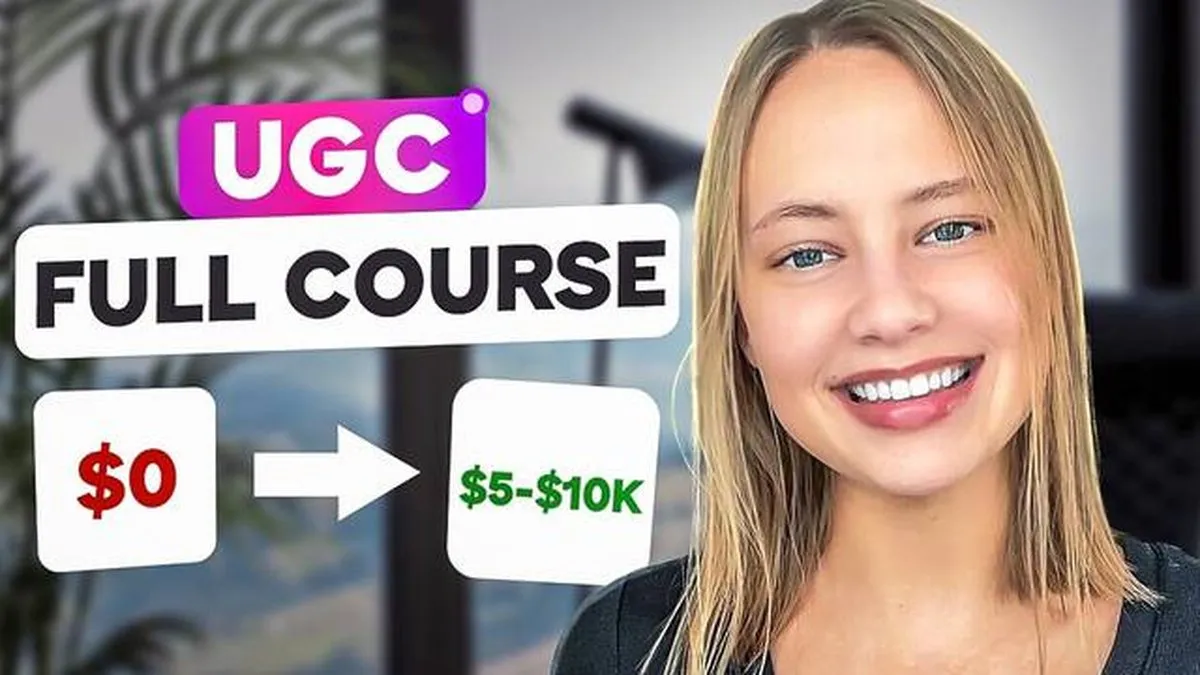
How Much to Charge for UGC: Why I Stopped Quoting $150 a Video
Key takeaways
- The $150 UGC 'industry standard' is a number creators pass around to each other. More than half the brands Gloria has worked with don't know that number. They're used to paying influencers $10K for a single post.
- Gloria's starting recommendation for beginners is $200 to $300 a video, sold as packages (three videos for $450, five for $800) so no collab drops below roughly $450.
- Price on what the video is worth to the brand. A $1,500 video that brings a supplement company $20,000 in revenue is a 13x return, and that return is what the brand is buying.
- Skip the rate card. Get the brand on a call, ask for their budget and how many videos they need, then build a custom package with usage rights already inside the price.
- Raising your rate is a test you run on real emails. Gloria sent $1,500 instead of $500 to four brands in one morning, and two of them came back with deals above her old rate.
I was 18, working at Walmart, and charging $150 a video for UGC on the side. It felt fair. I was new, I had no past work to show, and I believed brands would always find someone willing to do it for $100.
Then a brand owner sent me a DM. I had just delivered her video. She had already paid me the $150.
Gloria, thank you for the video. I love it. I just want you to know. I would have paid you $1,000 for this. you're really good. I think you should raise your rates.
The brand owner's DM, as Gloria shared it in a Skool post, 2026-06-10
I stared at that message for about 20 minutes. Nothing made her send it. The video was paid for, the work was done, and she never had to see me again.
Yet she went out of her way to tell me I had undercharged her by $850. That brand is still a client today, and she pays me $1,500 per video now. Same iPhone, same lamp, a different number.
That $150 had nothing to do with the value I delivered. It had everything to do with how afraid I was of being told no. If you're working out how much to charge for UGC, start there. UGC means user generated content: short videos a regular person films on a phone about a product, which a brand pays for and uses in ads or on its own pages.
How much should you charge for your first UGC video?
My starting recommendation for a beginner is $200 to $300 a video, and I'd never sell just one. Bundle videos into packages so every collab is worth around $450 or more.
I teach this exact number in my free course:
Start at $200 to $300 a video. Offer packages like this, like three videos for $450, five videos for $800 to avoid small collabs.
Gloria Stonelake, How to become a UGC Creator, 3:28:59
The package is the part beginners skip. If $450 is your smallest package, that's the floor. When a brand asks for one video, tell them you can do three.
Skip the platforms and apps that pay $50 a collab. Don't even start there.
Where does the "industry standard" UGC rate come from?
Nobody sets it. The $150 a video figure gets passed between creators, and in my experience most brands have never heard of it.
When I quoted $150, I thought I had done the research. I hadn't.
I'd done no research. I'd just picked a number that felt like it wouldn't embarrass me if someone said no.
Gloria Stonelake, Skool post, 2026-06-10
More than half the brands I've worked with didn't know $150 was supposed to be normal. They were used to paying influencers $10K for a single post. My $150 was a confession of how much rejection I was able to handle before I flinched.
Ask yourself where your number came from. If the answer is "other creators charge it," you picked it the same way I did.
Price UGC on what the video is worth to the brand
Your rate should reflect the business result your video produces for the brand, not what other creators charge for filming.
At a networking event I met a creator in my niche. Same content style, similar quality. She charged $150 per video and I charged $1,500. I asked how she came up with her rate, and she said she looked at what other creators were charging and priced herself "competitively."
When a supplement company pays me $1,500 for a video that brings them $20,000 in revenue, that's a 13x return on their investment. They're not thinking about what other creators charge. They're thinking about results.
Gloria Stonelake, Skool post, 2025-12-01
Competitive pricing sounds smart, and in the creator world it turns into a race to the bottom. Brands compare your video to the money it makes them.
She was selling videos. I was selling outcomes.
Gloria Stonelake, Skool post, 2025-12-01
To price on outcome, you have to say the outcome out loud. This is how I pitch my ad tester package on a brand call:
I really think my ad testers package would do wonders. It's just $600. It's made to make sure that we find a winner, generate ROI, and help you figure out your long-term growth strategy and content angle to scale.
Gloria Stonelake, How to become a UGC Creator, 3:18:39
ROI is return on investment: what the brand gets back for every dollar it spends with you. Write one sentence about the result your videos create before you write a single number.
Why I never quote a brand one video
A single video gives the brand one shot at finding an ad that works, so I always pitch a package of two to five videos.
When I pitch a brand, first of all, I never pitch a brand with one video. No, I always offer a package. A package is like two, three, four, five videos at a time.
Gloria Stonelake, 7 mistakes I made when growing from 0 to $10k/m, 0:20:35
Brands need to test. The more ads they run from you, the better their odds of finding a winner. Offering one video does them a disservice.
My favorite package is what I call the ad tester. It's $600 for one body, three hooks and two calls to action. A hook is the first line or shot that stops someone scrolling. I film each piece separately and hand the brand the variations, so their team can run them as different ads.
My ad testers come in six-video and 12-video packages, and organic packages come in two or four videos.
A package pitch over email can be this short: a three-video package, three proven hooks your competitors are already using (a reaction hook, a podcast-style hook and one with my sister in it), mixed and matched for your Meta campaigns, and for a package like this it's $1,000.
When you're ready to build bigger offers, my breakdown of UGC packages and upsells walks through raw footage, extra hooks and photos.
Why I don't send a UGC rate card
A rate card hands the brand a menu, so they pick the smallest item and ask for a discount on it. I build a custom package for each brand instead.
Send a brand a rate card and they come back with "I want one deal from you, but I want it for 150 instead of 200." You handed them every tool to do it.
The same thing happens when creators list prices on their portfolio. If a brand sees $150 a video before you've spoken, they start negotiating down from $150, and you lose the room to sell them what they actually need.
this is a service-based business. You can price your service however you want to. No one's forcing you to keep the same rate every collab.
Gloria Stonelake, How to become a UGC Creator, 1:15:41
I've charged $500 a video for some brands and $200 for others, depending on the size of the brand. That's normal for a service business.
My process looks like this:
-
Put a "book a call" link on your portfolio instead of a price list.
-
On the call, ask their budget and how many videos they need.
-
Build a package that fits the budget and the video count. One brand told me she had $1,500 a month for eight organic TikTok videos, so I said, "Okay, $1,500. I can do eight videos for you." She stayed with me for a couple of months.
-
If the math lands above their budget, meet the budget with fewer videos. When my bundle came to $2,500 and the brand had $2,000, one option I gave was eight videos for $2,000 instead of ten.
-
State the price, then stop talking.
Once I say the price, I don't say a word until the brand agrees or asks a question. I answer the question and go quiet again. No babbling. Wait for a straight answer.
The more videos a brand buys, the lower the price per video. My $1,500 for eight came out to a little under $200 each, and it was $1,500 coming in every month. Look at the total like a business owner. If a brand tells you there's no money at all, read what to say when a brand has no budget for UGC.
Should you charge UGC usage rights separately?
Usage rights are the permission a brand pays for to run your video in ads or on its pages for a set time. I fold them into my base price so the brand owns the content and never gets a second bill.
Lots of creators treat usage like rent. The video stays theirs, and the brand pays a fee, sometimes 50% of the base rate, to use it for three or six months. Some bill $100 every month for it.
I don't charge usage rights because I actually add the usage rights fees into the fee at the beginning. Meaning my videos cost $300 a video instead of $200 a video.
Gloria Stonelake, How to become a UGC Creator, 1:18:49
From what I've seen, video ads tend to run out of steam around the three-month mark, so I average it out and give the brand the content for good. On a call I say something like: yes, it's $300 a video, I don't charge usage rights, and the price already covers it so it's never a headache for you. Brands have told me they had never heard that before.
You can charge usage monthly if it makes sense for your business, especially for software companies that reuse content for a long time. Just decide on purpose. The full breakdown is in my post on UGC usage rights.
How do you raise your UGC rates?
You raise your rate by quoting the new number on your next real pitches and watching what brands do. That one morning showed me my ceiling was nowhere near where I thought.
I remember this day vividly. It was 8:14 on a Tuesday morning and I was sitting on my floor in Indonesia with a matcha, going through brand emails. Four brands were waiting for my rate. For three months I'd been quoting $500 for a 60-second video, and it felt comfortable.
On the spot, with zero plan, I typed $1,500 into the email and hit send before I had time to second-guess myself. Same exact work, three times my rate. Then I closed my laptop and went to the beach, fully expecting all four to ghost me by lunch.
- 12:47pm: the first brand countered at $1,000, still double my old rate.
- 2:03pm: the second said it was out of their budget.
- 3:30pm: the third wrote back, "Cool. Can we lock in a 4-video bundle for $5,500?"
- The fourth never replied.
Two of the four came back ready to pay more for the same work. Over time I went from $150 to $750, then $1,500, then $2,000. The videos didn't suddenly get better. My equipment stayed the same.
when you act like the number is the number, the number becomes the number. when you act like the number is up for debate, you've just told them what to do.
Gloria Stonelake, Skool post, 2026-06-03
Send your next pitch at a number above the one you're used to. Detach from your "comfort rate." It's a number on a screen.
What to say when a brand says your rate is too high
Ask how their cheaper videos actually performed, then help them compare cost against results.
When a brand tells me other creators charge less, I ask whether those videos brought in sales or just views. Most brands that come to me after paying less found the content didn't move the needle. Then I ask a question that does the work for me.
If someone offered you a $500 Ferrari to drive across the country, would you trust it to get there?
Gloria Stonelake, How to become a UGC Creator, 3:24:21
Cheap content costs more in testing, reshoots and missed sales. A video that makes their ad budget go further is worth paying for. For the full scripts, including the gifted collab and commission-only objections, read how to negotiate UGC rates.
One more filter I use: your hourly rate. When I was a full-time creator, I worked out that I was making around $170 an hour. If your math lands under Walmart's starting pay of $17 an hour, look at your price and at how long you take to make each video. Perfectionism is what drags most creators down there.
To see what other creators have actually reported, read how much UGC creators make.
The brand owner who DMed me at 18 saw what I couldn't. Your rate tells a brand what you believe your work is worth before they ever press play. Pick a number you can say with a straight face, and say it.
Gloria
Every figure in this post is from my own deals or my own advice to beginners. It isn't a prediction of what you will earn. Your results depend on your work, your niche and the brands you pitch.
Frequently asked questions
How much should a beginner charge for UGC?
Gloria recommends starting at $200 to $300 a video and selling them in packages, such as three videos for $450 or five for $800. Her rule is that every collab lands around $450 or more, so if a brand asks for one video, offer three.
Should I put my UGC rates on my portfolio?
Gloria keeps rates off her portfolio. If a brand sees $150 a video before you talk, they negotiate down from that number and you lose the room to build a bigger package around what they actually need.
Should I charge extra for UGC usage rights?
Gloria builds usage rights into her base price instead of billing them separately, so her video costs $300 instead of $200 and the brand keeps the content. Some creators charge usage monthly, which she finds turns into a headache for both sides. Either approach works if you price it in on purpose.
Do I need a UGC rate card?
Gloria does not use one. A rate card works like a menu, so the brand picks the smallest item and asks for a discount on it. She asks for the budget and video count on a short call and builds a custom package from there.
How do I raise my UGC rates?
Quote the new number on your next pitches and watch the replies. Gloria moved from $500 to $1,500 for the same 60-second video in a single morning; one brand countered at $1,000, one said no, one asked for a four-video bundle at $5,500 and one went quiet.
About the author. Gloria Stonelake is co-founder of UGC World and Head of Creator Talent. She took home over $150K in one year from UGC, then built the agency brands pay to staff their campaigns with trained creators. Meet the UGC World team.
UGC World is a personal and business finance education and training company. Results described here are the experiences of the named creators and are not typical. Success depends on implementation and effort. We do not make claims about what you should expect to make.

