Before You Sign a UGC Contract, Check These 8 Terms
Key takeaways
- Gloria never delivers UGC without a signed contract, after her first paid campaign stopped replying once she had filmed and delivered the video on time.
- Her baseline terms are half the payment before filming, a kill fee for late cancellations, gifted product counted inside total compensation, and no exclusivity unless it is paid for.
- Usage rights deserve a triple check: confirm whether the brand gets the videos forever or leases them, and on which channels, organic or paid.
- David, a creator in the UGC World community, reported contracts from larger UGC platforms that let them build unlimited AI avatars of you after one shoot, so read the AI usage language before you sign.
- An uncured breach clause sets a response window for the brand. If the brand misses it and the grace period after it, the contract defaults and you keep your milestone payment.
My very first paid UGC campaign came in through email. The brand sent me a brief, and I was so excited to land the deal that I skipped every formality.
There was no UGC contract and nothing in writing about when I would get paid. I said yes, shot the video and delivered it on time. Then I waited for payment.
Weeks passed and nothing came. Eventually the brand stopped replying altogether. I sat there with a finished video and no way to push back, because nothing in writing said they owed me a single dollar.
A little later, a different brand cancelled a project the day before I was supposed to shoot. I had already booked props, cleared my schedule and spent time preparing. All of that work went in the trash.
I learned then and there: no matter how excited you are to land the deal, you never deliver content without a contract in place.
Gloria, Skool post, 2025-05-07
A UGC contract is the written agreement between you and the brand about what you make, what you get paid, when you get paid and how the brand can use your videos. UGC means user-generated content: short videos you film on your phone that brands run on their pages and in their ads.
Most of the terms below I learned from my own mistakes or my friends' horror stories. None of it is legal advice.
Why do you need a UGC contract for every deal?
You need a UGC contract because without one you have nothing to stand on once the video leaves your hands. I delivered my first campaign on time and still had nothing to push back with when the brand went silent.
There is a second problem once you do get a contract. Most contracts are written to protect the company. Your job is to read the brand's template for the gaps that leave you exposed and ask for the terms below before you sign.
Plenty of new creators skip contracts because they worry it makes them look difficult or too formal. Here is what I tell them.
the right brands respect creators who take their work seriously.
Gloria, Skool post, 2025-05-07
In my own videos I say it plainly: the collab becomes official the moment you both sign. The pitch and the emails before it are the lead-up.
This is where the UGC collab starts is right when you sign that contract. That's when it makes it completely official.
Gloria, YouTube, 0:02:02
If you have already been burned and a brand owes you money right now, read what to do when a brand doesn't pay your UGC invoice next.
How should payment work in a UGC contract?
Ask for half the payment before you start filming. After that first campaign went silent, I started requiring half up front before I ever touched my camera.
The upfront half protects you if a brand changes its mind halfway through. You are no longer the only one with something at risk.
The worst move you can make is deliver an entire set of content without securing at least partial payment. That is exactly what I did on deal one, and then the brand stopped replying.
Never send finished videos to a brand that has paid you nothing and signed nothing.
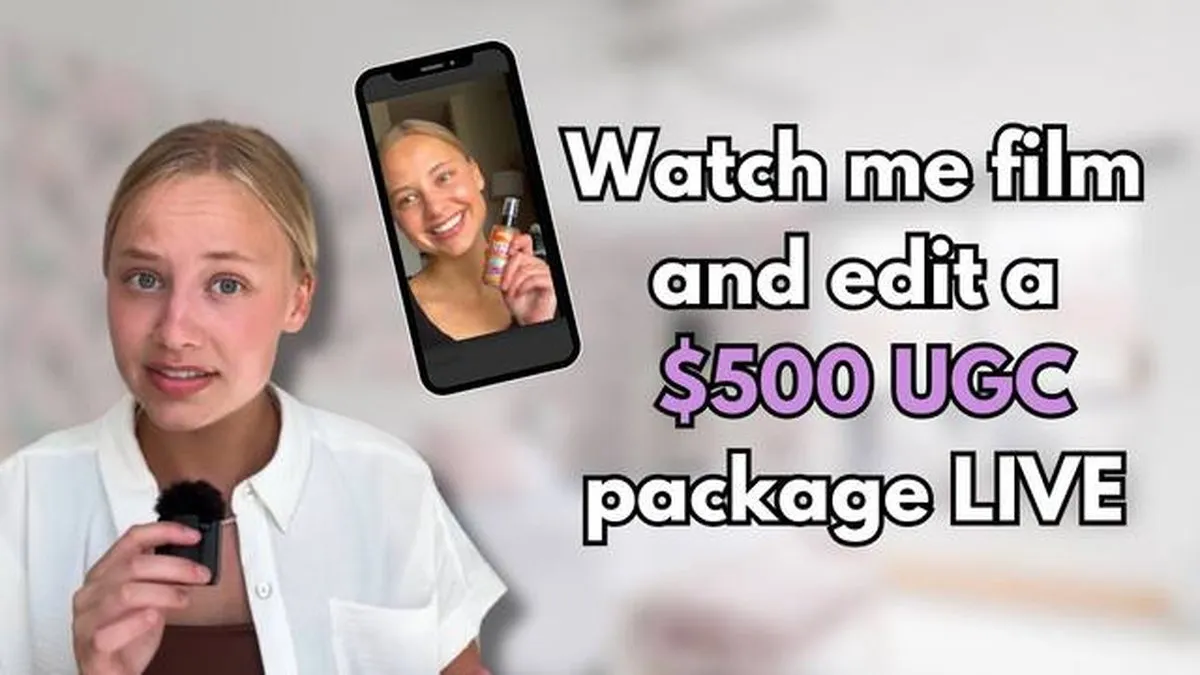
In my live filming tutorial, the deal was $500 for two videos for a skincare brand. The brand left me on delivered for weeks, I followed up twice, and then they sent over their contract. Before I signed, I checked it against everything we had agreed on in the email thread: the rate, what I was delivering and the usage rights. If any of those three do not match your emails, stop and fix it before you sign.
What is a kill fee in a UGC contract?
A kill fee is a clause that says if the brand cancels, it still owes you a portion of the fee for the time and prep you already invested. I added one after a brand cancelled the day before my shoot.
By the day before a shoot, the prep is already done. In my case the props were booked, my schedule was cleared and the planning time was spent. A cancellation at that point wipes all of it out unless your contract says otherwise.
Write the kill fee into the contract before you set a shoot date. The clause only has to say one thing: if the brand cancels, it still owes you a portion of the fee for the time and prep you already put in.
Gifted product, exclusivity and liability terms in a UGC contract
Put gifted product inside your total pay, refuse unpaid exclusivity and add a line that you are not liable for how the brand uses your content. These are the terms I see creators miss because none of them shows up as a rate.
Count gifted product inside your compensation
Nobody warned me about this early on. Gifted products are not free. The IRS counts them as taxable income, and if you are getting paid and also getting product, you risk reporting it twice.
My fix: I list the product inside my total compensation on the contract, so it is treated as one unified payment instead of two separate things. Talk to a tax professional about your own situation. If brands keep offering you product instead of money, read why gifted collabs kept me unpaid.
Never give exclusivity away for free
Exclusivity means you agree not to work with competing brands in the same niche. Some brands slip it into the contract without offering any extra pay.
My contracts always say that unless exclusivity is explicitly agreed on, with extra compensation, I am free to work with other brands, even in the same category. If a skincare brand wants to lock you out of every other skincare brand, that is worth real money to them, so it should be worth real money to you.
Limit your liability after delivery
I did not think about liability at all at first. Then I asked myself what happens if a brand uses my content in a way that causes harm or breaks some regulation.
Now my contracts include language that says I am not responsible for how the content is used after delivery. If legal problems come from the brand's misuse, I am not on the hook.
How to read usage rights in a UGC contract
Usage rights are the terms that say how long and where a brand can use your videos. Triple check this section of every UGC contract. When I run contracts through ChatGPT, usage rights land in the red flags list every time.
There are two sides to usage rights. Forever usage means you hand the videos over and the brand owns them forever. Leased usage keeps the content yours on paper, and the brand pays you to keep running it, typically every 90 days. The average usage rate for a creator that I gave in my tutorial is roughly an extra 50% or more of the base rate for each 90-day cycle, because 90 days is about how long a good UGC ad keeps performing, if not longer, around 180.
In my skincare contract, I allowed forever usage because we had discussed it. The scope covered both organic social posts and paid ads. That was the deal we agreed to in email, so it was fine.
The danger is when it shows up without a conversation. Some brands like to sneak forever usage into the contract when you never discussed it. Discuss usage rights with the brand before you sign any contract.
I explain how I price the leased side, and how one video earned more without refilming, in my guide to UGC usage rights.
The AI likeness clause showing up in UGC contracts
An AI likeness clause gives a company the right to create AI versions of you, your face and your voice, from the footage you film. Check for it in every contract now, especially from larger UGC platforms.
David, a creator in our UGC World community, posted a warning about this in March 2026. He had been getting contracts from larger platforms that gave them the right to create unlimited AI avatars of him after he filmed the original ad.
Here is what that means in practice. You film one script with a few hooks and get paid once. The contract then lets the company recreate you with AI for future ads. In theory, a single $200 to $300 video turns into dozens or even hundreds of ads with your likeness in them, with no extra pay to you.
David has started turning these contracts down. The AI language he does accept lets a brand use AI the way a human editor would, for things like editing, resizing and voice cleanup, and rules out any reproduction of his likeness or creation of an avatar. He also asked one of the platforms if this was going to be standard and never heard back.
What you allow is your decision. Just make it on purpose. Search every contract for the words AI, avatar, likeness and voice, and read every sentence around them before you sign. If you want the same line David uses, ask for AI to be limited to editing, resizing and voice cleanup, with no reproduction of your likeness and no avatar.
Add an uncured breach clause for brands that go silent
An uncured breach clause sets a deadline for the brand to respond, and if they miss it, the contract defaults in your favor. I wrote about it for our community because the same story keeps happening: you get the brief, you start filming, and then the brand disappears.
That is my first campaign all over again. You did the work, you cannot finish without their input, and you start wondering if you will ever get paid.
Here is how the clause works:
-
The brand agrees to respond within a set window of seven to fourteen business days.
-
If they miss that window, they are in breach of the agreement.
-
If they do not fix the breach within a grace period, about another seven days, the contract defaults.
-
You keep the milestone payment, the project is paused or cancelled, and you are free to move on.
The sample language I share with creators reads like this: the client agrees to respond to all delivered videos and requests within seven business days, failure to respond within fourteen business days constitutes an uncured breach, and in that case all milestone payments are non-refundable and the project is considered complete.
Get the brand to agree before you start. Have them initial or sign that section. Then if they go quiet, you send a professional message that says, according to our agreement, you need a response within the next 48 hours or the contract will default.
This is not aggressive. This is business.
Gloria, Skool post, 2026-02-17
How I run a UGC contract through ChatGPT before signing
Download the raw contract the brand sent you, upload it to ChatGPT and ask it to summarize the main points and flag red flags. I do this after I read the contract myself, because a long document goes in one ear and out the other.
This is the exact prompt I typed in my tutorial:
analyze this contract and summarize it in a few main points and point out any possible red flags in it that I shouldn't overlook
Gloria, YouTube, 0:03:04
Then I go through the summary line by line and compare it with my email thread. Here is the checklist I work from:
-
Parties and payment: the names and the amount match what we agreed.
-
Scope of usage: organic, paid or both, and for how long.
-
Term and termination: when the agreement ends and how either side can end it.
-
Content rights: forever or leased, and whether we actually discussed it.
-
Pre-approval: whether every video has to be approved before it counts as done.
-
Expenses: make sure they do not require you to buy anything for the collab.
-
Revisions: if the contract says nothing about revision limits, that brand is relaxed about it. I still offer revisions so the final video is my best work.
In my skincare contract, ChatGPT flagged usage rights and a pre-approval clause. Neither was a problem for this deal. A pre-approval line is exactly the kind of detail that slips past on a first read, and that second pass catches it.
Once both sides signed, I delivered through a Google Drive link and did not bother with a watermark, because the signed contract already protected me. With no signed contract, get one signed first. If you are very skeptical of a brand, add a watermark. For more warning signs to watch for, see the UGC brand red flags and scams I learned the hard way.
What happens after you sign: deliver, follow up, get paid
After you sign, you deliver the videos, follow up if the brand goes quiet and send your payment details when they ask. The contract is what lets you follow up calmly, because the terms are already agreed.
On that skincare collab, I delivered both videos through Google Drive. The brand went quiet for almost a week, so I followed up. A day later they replied that they would put my payment request in the queue and asked for my PayPal email. I sent it, and they paid me.
A brand that respects your contract is the kind of brand worth keeping. When one starts asking for more videos every month, use my process for turning one-off deals into a monthly UGC retainer and carry the same terms into it.
when you act like a business, you get treated like one.
Gloria, Skool post, 2025-05-07
This post shares Gloria's personal experience and the experience of creators in the UGC World community. It is not legal or tax advice. For a contract you are unsure about, talk to a qualified lawyer or tax professional.
Frequently asked questions
What should a UGC contract include?
At minimum: the rate, the deliverables, the payment schedule, the usage rights (how long and where the brand can run the videos), and what happens if the brand cancels. Gloria also adds a kill fee, an exclusivity clause that requires extra pay, a liability line for how content is used after delivery, and limits on AI use of her likeness.
What is a kill fee in UGC?
A kill fee is a clause that says if the brand cancels the project, it still owes you a portion of the fee for the time and prep you already put in. Gloria added one after a brand cancelled the day before her shoot, when she had already booked props and cleared her schedule.
Can I use ChatGPT to review a UGC contract?
Gloria downloads the raw contract, uploads it to ChatGPT and asks it to summarize the main points and flag red flags. She reads the contract herself first and uses the summary as a second pass to catch things like forever usage or pre-approval clauses. A summary is no substitute for legal advice on a contract you are unsure about.
Should I sign a UGC contract that allows AI avatars of me?
That is your call, and it deserves a careful read. David, a creator in the UGC World community, has started turning down contracts that let a platform recreate him with AI after one paid shoot, and only allows AI for normal editing work like resizing and voice cleanup.
What is an uncured breach clause?
It is contract language that requires the brand to respond within a set number of business days. If it misses that window and does not fix it within a grace period, the contract defaults, you keep the milestone payment and you are free to move on.
About the author. Gloria Stonelake is co-founder of UGC World and Head of Creator Talent. She took home over $150K in one year from UGC, then built the agency brands pay to staff their campaigns with trained creators. Meet the UGC World team.
UGC World is a personal and business finance education and training company. Results described here are the experiences of the named creators and are not typical. Success depends on implementation and effort. We do not make claims about what you should expect to make.

