UGC Packages: How My $300 Video Became a $700 Deal
Key takeaways
- Gloria says $500 for a 30 second UGC video rarely comes from one gig. It usually starts as a $200 or $300 deal and grows through usage rights, raw footage, extra hooks and extra calls to action.
- On a first collab with one brand, Gloria offered a one-time discount, overdelivered, and says that brand paid her $3,300 over the next five months.
- Gloria's base rate covers 30 days of usage on one platform. Longer runs and more platforms are billed as separate usage fees, which is how one $300 skincare video became $700 with no extra filming.
- The six add-ons Gloria offers even on a first deal are usage rights, B-roll packages, raw footage, organic posting, extra hooks and additional calls to action written against buyer objections.
- Gloria pitches upsells in three waves: at delivery, after posting the video organically, and with a price anchor once the brand is talking about licensing.
I filmed one simple ad for a skincare brand. It was a $300 project. They wanted one short video for testing, I delivered it, they liked it, and I thought I was done.
Six months later an email came in. The ad was performing well and they wanted to keep running it for another 180 days.
My price for that was already set, based on time and platform. So I sent the invoice for extended usage rights.
That one email turned my $300 project into a $700 one. No extra filming, no extra work.
Gloria Stonelake, 2:31
With another brand, I went below my normal rate on the first collab. I gave them a one-time first-collab discount and overdelivered. They have paid me $3,300 over five months of working together.
Both deals grew because of UGC packages. UGC (user-generated content) means short videos you film on your phone that brands run as ads or post on their pages. A package is the base video plus the paid extras a brand buys on top. Below is the menu I sell from and the moments I offer each piece.
What are UGC packages, and why do they pay more than single videos?
A UGC package is one deal built from several paid pieces: the video, the rights to use it, and the extra assets a brand needs to test and scale it. Packages pay more because the brand is buying a result, and a single file is the smallest version of that result.
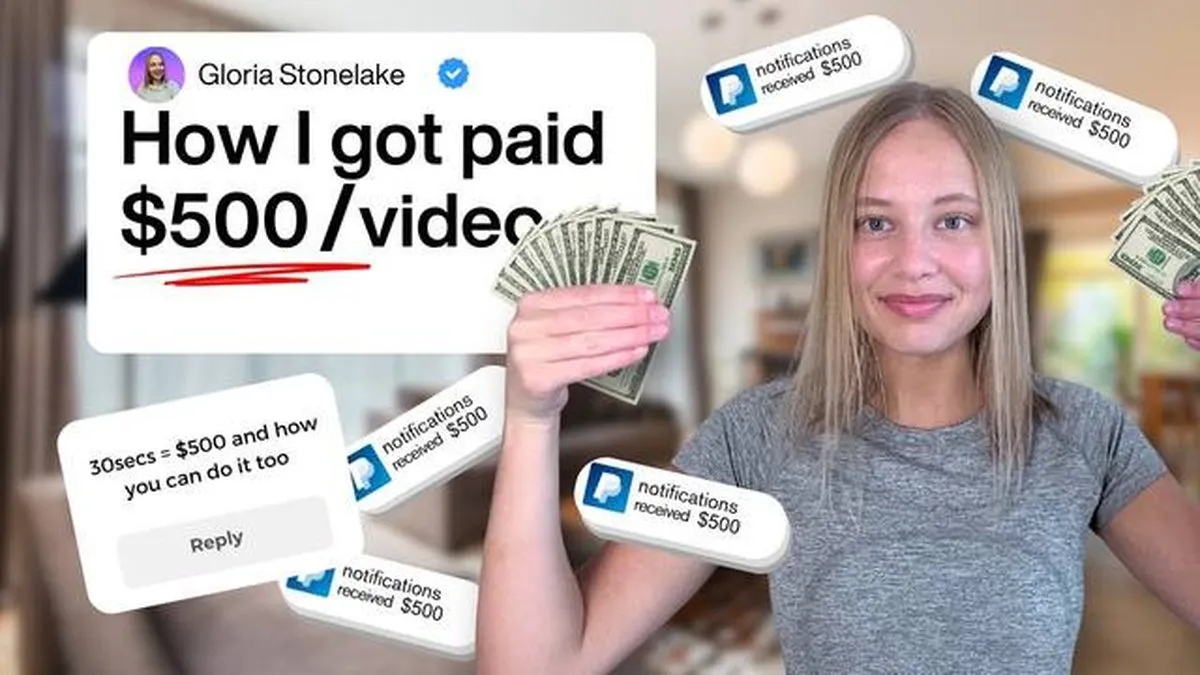
You have probably seen creators post that they got $500 for a 30 second video. In my video I called that number mostly fake. The deals exist. They just rarely show up as one clean payment.
It usually starts with a smaller $200 or $300 deal up front. Then you upsell. You stack on usage rights, raw footage, additional hooks, and extra call to actions.
Gloria Stonelake, 0:30
I wrote about this in my community in May 2025. Anyone can get "a video" from another creator, a freelancer marketplace or an in-house intern. If a file is all you sell, you are competing with all of them on price.
Sell to the brand you already have before chasing a new one. An existing client already trusts you, and that trust is the hard part of any deal.
It's easier to sell to existing clients than to sell to new ones. The trust is already built.
Gloria Stonelake, 2025-05-06
The math I gave in that post: turn a $100 one-time deal into a $1,000 retainer, then keep that retainer for a year and it is $10,000 from one brand.
If you want the full picture on setting your base number first, read how much to charge for UGC.
Should you discount your first UGC collab?
Yes, once, and only with a plan to get more later. I tell creators a one-time discount of 10 to 50 percent is fine for a first collab when a brand lowballs you or says they don't have the budget.
The way you say it matters as much as the number. In March 2025 I laid out the reply I use:
- Tell them your rates reflect the quality of your work, the same way their product prices reflect theirs.
- Let them know the industry standard, which I put at $200 to $300 per video.
- Offer a one-time discount, clearly labeled as a first-collab offer.
- Explain that you are offering it because you believe you can help them.
Then make the collab ridiculously easy. Quick replies, quick delivery, a small extra as a first-time collab gift, extra free revisions. A brand that clearly needs UGC now will most likely need more later. The $3,300 brand started exactly this way.
SEED yourself into their marketing strategy.
Gloria Stonelake, 2025-03-01
That discounted first project can open the door to a monthly retainer. A retainer is a monthly agreement where a brand pays you a set amount for ongoing content. I break down that step in how I turn one-off deals into a monthly UGC retainer.
Which UGC add-ons can you sell on your very first deal?
You can offer six add-ons on day one: usage rights, B-roll packages, raw footage, organic posting, extra hooks and additional calls to action. I put all six on the table even on a first deal.
Usage rights
Usage rights are the permission a brand has to run your video, for how long and on which platforms. This is the upsell I call the most slept on, and the easiest one to set up.
You should never include unlimited usage in your base rate. You start with 30 days, one platform, that's it.
Gloria Stonelake, 5:04
When the brand comes back and says the ad is working, you charge for the extra time and the extra platforms. Sell it as monthly, quarterly or yearly licensing. The longer they run it, or the more platforms they put it on, the more they pay. That is the whole reason my skincare video went from $300 to $700.
Usage pricing has its own rules, and I cover them in UGC usage rights.
B-roll packages
B-roll is the extra footage around your main shot: close-ups, packaging shots, lifestyle angles, product interactions. Film it every time, even when it never makes your final cut. Brands need variety for editing, split testing and future campaigns, so drop those clips in a folder and offer the folder as an add-on.
Raw footage
Raw footage is your unedited source file. Brand teams and agencies love it because they can change pacing, subtitles or cuts on their own. When a brand asks for edits, that is your cue. My line: "Sure, I offer full raw footage delivery for X price."
Organic posting
This means posting the video on your own feed and tagging the brand. A small audience still gives them social proof, because viewers see a real person backing the product outside of an ad. My line: "Want me to post it on my feed as well? I can include that as part of the package."
Extra hooks
A hook is the first three seconds of a video, the part that stops the scroll. If the hook doesn't grab attention, the ad dies and the rest of the video doesn't matter. My line: "I can film two or three alternative intros for testing."
You're already in front of a camera and it takes maybe 10 extra minutes, but it gives the brand a massive edge in split testing.
Gloria Stonelake, 7:36
Additional calls to action
A call to action (CTA) is what you tell the viewer to do next, like "buy now" or "click the button below." Write extra CTAs that answer objections, meaning the reasons someone hesitates to buy:
- "What if it doesn't work?" pairs with "try it risk-free."
- "It's too expensive" pairs with "limited time discount."
- "Shipping is too expensive" pairs with "free shipping today."
- "Where do I buy it?" pairs with "click the button below."
The brand tests which ending converts best. Your value to them goes up because you are thinking like a marketer.
When should you pitch a UGC upsell?
Pitch when the brand already sees value. I upsell in three waves, and each one lands at a moment when saying yes feels natural to them.
Wave one is delivery. The brand is happy, the content is in their hands and they can see what they paid for. That is when I plant the seed.
By the way, if you want to use this for ads, I can license you full usage rights.
Gloria Stonelake, 3:01
The second wave comes after I post the video organically and tag the brand. Once they see engagement and positive feedback on my page, the next line is easy.
Looks like your audience is responding well. If you want to scale this further, I can license the footage for paid ads, too.
Gloria Stonelake, 3:31
Last comes the pitch itself. When the conversation turns to licensing, I anchor the price. A price anchor is a higher reference number you name first, so your real offer feels like a good deal.
Normally, brands pay me $2,000 for full commercial rights, but since you're a repeat client, I can do it for X amount or $1,000.
Gloria Stonelake, 3:31
Now $1,000 feels like a discount, even though the deal just got bigger. In every wave the brand already sees the value, so you are guiding them to invest more into what is already working.
How do you turn one UGC video concept into multiple paydays?
Reuse the format, change the details, and sell it again. A good concept has more than one buyer, and one filming session holds more than one paid piece.
I've sold the same "morning routine" concept to 8 different brands.
Gloria Stonelake, 2025-08-22
I kept the winning format each time and changed the products and the hook. Take a concept that worked for one skincare brand and adapt it for the next brand in the same space.
Here is the rest of the list I shared in August 2025:
-
Multiple formats. One recording becomes a 60-second TikTok, a 30-second Reel, a 15-second story and a horizontal YouTube version. Most brands pay extra because it saves them editing time.
-
Series content. Pitch four parts instead of one video: unboxing and first impressions, a day 3 update, a full review, final results.
-
Seasonal repurposing. A summer skincare routine becomes a winter one with small changes. A back-to-school organization video works for spring cleaning too.
-
Performance bonuses. ROAS (return on ad spend) is how many dollars of sales an ad brings in for every dollar spent on it. The line I shared: "If this video hits over 2.5x ROAS, I'd like to discuss a performance bonus and ongoing partnership."
-
Bundles. Pair the video with email copy, social captions or Pinterest graphics. Plenty of brands prefer one person for multiple assets.
Same amount of filming time, 4x the payment.
Gloria Stonelake, 2025-08-22
Before you film any project, ask yourself one question. How do I get the most value out of this time?
What backend UGC assets do brands pay for beyond ads?
Backend assets are videos a brand uses deeper in its sales process: thank-you page videos, abandoned cart videos, video sales letters (VSLs) and internal training content. The point is to think beyond ads.
A thank-you page video plays right after someone buys. An abandoned cart video reaches a shopper who left without checking out. A VSL is a longer video that walks a viewer through why to buy. Training videos teach the brand's own team.
I've personally turned $1k gigs into $5k+ by understanding a brand's full funnel.
Gloria Stonelake, 2026-01-14
Coach Mike in our community is the person I send creators to for this skill.
When you sell assets tied to sales, you price against outcomes. I go deeper on that in how to charge more for UGC by selling outcomes.
Why does a system make upsells happen every time?
A system makes upsells repeatable because it removes the moment where you forget, hesitate or feel too tired to ask. Strategy helps you make content. Systems help you make money.
Strategy is like cooking one great meal. Systems are like owning the restaurant.
Gloria Stonelake, 9:08
Anyone can follow a recipe and cook one amazing dinner. Serving hundreds of people a day takes prep, staff, schedules and workflows. Without them, you are stuck in the kitchen plating every dish yourself.
Without a system, you're guessing. You upsell one client but forget on the next five.
Gloria Stonelake, 10:40
Every deal that enters your pipeline should trigger the same upsell steps. Build these four pieces this week:
-
Copy-and-paste upsell scripts. The lines on this page for delivery, the organic post, raw footage, hooks and the licensing pitch are a starting set.
-
A pricing calculator for usage by time and platform, so you quote with confidence.
-
Saved templates for your emails and invoices.
-
A tracker for your pipeline, either a spreadsheet or a CRM.
Build that once and the upsell stops depending on whether you feel tired, busy or unsure that day. Every deal on this page grew past the first payment. The first video is just the beginning.
Disclaimer: The numbers on this page are Gloria's own results, shared in her words. They are not typical, and nothing here promises what you will earn. Your results depend on your skills, effort and the brands you work with.
Frequently asked questions
What should a UGC package include?
Gloria's base deal is the video with 30 days of usage on one platform. On top of that she offers usage extensions, a B-roll package, raw footage, organic posting on her own account, extra hooks for split testing and extra calls to action, each priced as its own line.
How do you upsell a brand on UGC without being pushy?
Gloria times the offer for moments when the brand already sees value: right at delivery, after the video gets engagement on her own page, and when the brand asks to keep running it. She frames each add-on as more value for a video that is already working.
Should I give a brand a discount on my first UGC collab?
Gloria says a one-time discount of 10 to 50 percent is fine for a first collab, as long as you explain why and then overdeliver. She did this with a brand that went on to pay her $3,300 over five months.
What are backend UGC assets?
Backend assets are videos a brand uses outside of ads, such as thank-you page videos, abandoned cart videos, video sales letters and internal training content. Gloria says she has turned $1k gigs into $5k+ by understanding a brand's full funnel.
About the author. Gloria Stonelake is co-founder of UGC World and Head of Creator Talent. She took home over $150K in one year from UGC, then built the agency brands pay to staff their campaigns with trained creators. Meet the UGC World team.
UGC World is a personal and business finance education and training company. Results described here are the experiences of the named creators and are not typical. Success depends on implementation and effort. We do not make claims about what you should expect to make.

