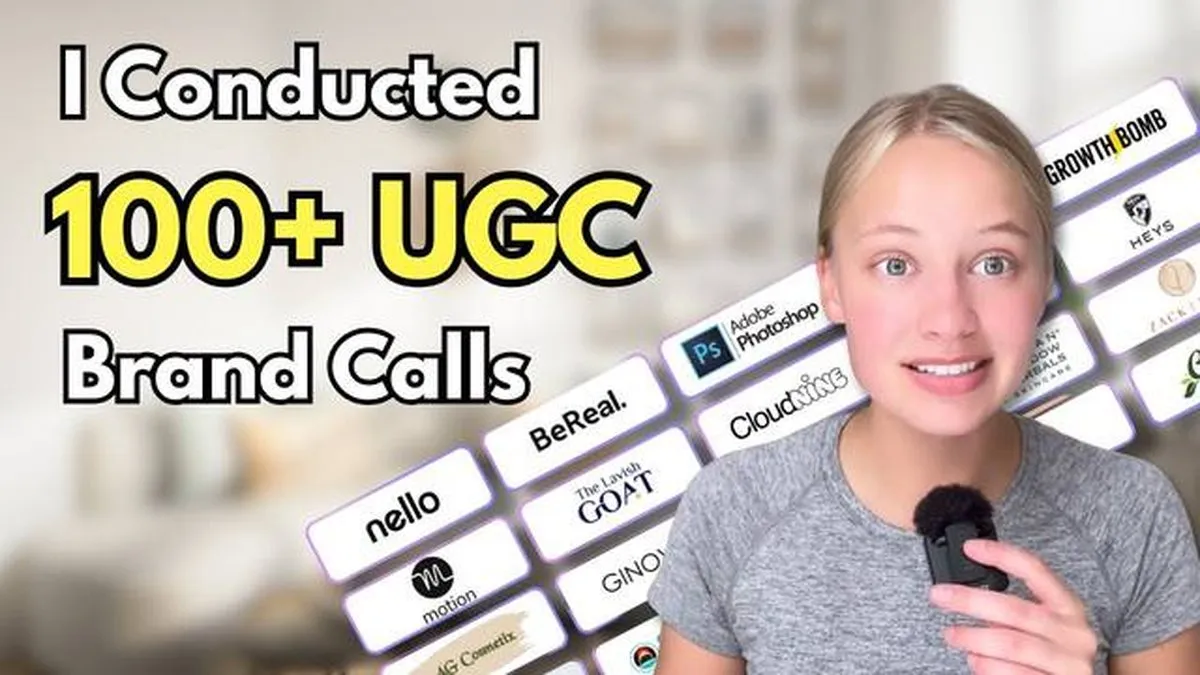
How to Negotiate UGC Rates: What 100+ Brand Calls Taught Me
Key takeaways
- State your UGC rate in one sentence, such as "my rate for this is $800," then stop talking and let the brand answer the silence.
- Adding "but I'm flexible" to a rate tells the brand your number is a starting point. One of Gloria's students said $800 with that line and the brand came back at $300.
- Gloria prices above a brand's stated budget on purpose. When a brand says its budget is $300, she counters with $500 to $700 because she expects them to negotiate down.
- Spend about 10 minutes before a brand call checking what competitors pay creators, the company's recent news, and how urgent the campaign is.
- Mike Provenzano wrote that he earned over $20K in January after enforcing his rates and walking away from a client who wanted five ads for the price of one.
I sat in on a coaching call with one of my students. She was on a call with a brand, and I had my mic muted on Zoom, just listening.
The brand asked her the simplest question there is: "What's your rate?"
She answered, "um, well, normally I charge $800, but I'm flexible and we can definitely work with whatever your budget is, especially because I'd really love to work with your brand."
I felt myself wincing in real time.
The brand rep paused for a second. Then the rep said, "okay. our budget for this is actually $300. would that work?" My student said yes.
After the call she got off Zoom with me and said, "Gloria, that didn't feel good. why did they push me down so much?" I had to tell her the truth. She folded before she even gave herself a fair shot.
I used to do the exact same thing. Fear of losing the deal made me undersell myself constantly.
When I first started landing brand deals, I would take whatever they offered. $100? Sure. $150? Amazing. Whatever you say, Mr. Brand Person, sir.
Gloria Stonelake, UGC World community post, 2026-01-05
Knowing how to negotiate UGC rates is the one skill I wish someone had told me about sooner. UGC means user generated content: short videos you film on your phone that a brand pays for and runs on its own pages or as ads. If you don't learn to negotiate for yourself, brands will negotiate for you, and that is how creators get stuck with gifted and low-paying collabs. Below is what I had my student practice, plus what I learned from over 100 brand calls of my own.
How do you negotiate UGC rates as a beginner?
You negotiate UGC rates by doing 10 minutes of research before the call, stating your rate in one sentence, and keeping quiet while the brand reacts. When they push back, you change the scope of the work and keep your rate. Each section below covers one of those moves.
I have taken over 100 live brand calls one on one with brand owners. Time and time again, I've watched creators who treat being grateful for any opportunity as a business strategy get lowballed.
I've been the desperate creator saying I'm flexible on price to brands spending 100K monthly on ads.
Gloria Stonelake, YouTube, 0:00:31
Those brands had money. I was the one who talked my own number down. If you have no number yet, start with how much to charge for UGC and come back here once you have one.
What should you research before a UGC brand call?
Before any brand call, spend about 10 minutes on three things: what similar brands pay creators, what is happening inside the company, and how urgent this campaign is. Most creators hop on calls blind, without knowing the brand's budget range, its campaign timeline or who actually makes the decisions.
Here is the order I go in:
-
Competitor rates. Look at similar brands in the same space to see what normal UGC rates look like there. If a competitor just ran a big campaign with creators at $1,500 a video, that is your benchmark.
-
Company news. Check recent funding, product launches and hiring announcements. A company that just raised a Series B round has a different budget from a startup paying out of its own pocket.
-
Campaign context. Work out whether this is a small test or their major Q4 launch. Urgent timelines and high-stakes campaigns pay two to three times normal rates.
Then ask better questions on the call. "What's your budget?" is the question most creators ask. The person who asks better questions controls the conversation, so I ask these three in its place:
-
What's your customer acquisition cost for video campaigns?
-
How are you currently measuring UGC performance?
-
What's worked best in your previous creator partnerships?
The answers give me numbers to price with, and they show the brand I think about their business and not just my own creative work. For more on what to ask, read the questions to ask on a brand call.
How do you say your UGC rate without backing down?
Say your rate in one sentence and stop. After that call with my student, this is the only line I had her practice in response to "What's your rate?":
my rate for this is $800.
Gloria Stonelake, UGC World community post, 2026-06-20
That's the whole answer. Close your mouth and let the silence sit.
The silence will feel unbearable, and you will want to fill it with apologies and discounts. Hold it anyway.
the silence is the brand processing your number. that's their job. your job is to hold the number and stop talking.
Gloria Stonelake, UGC World community post, 2026-06-20
Your confidence is a skill you can train. Meditate on it and rehearse the internal dialogue before the call. It starts in your mind about six seconds before you open your mouth, so practice there first.
Why "but I'm flexible" costs you money
Every phrase you wrap around your rate tells the brand how to treat it. My student's answer had four softeners in it: "um, well," then "normally," then "but I'm flexible," then the line about how much she'd love to work with them. The brand heard all four.
the second she added "but I'm flexible" to her rate. the entire negotiation was over. she'd already told the brand "the number I just said is a starting point. please respond with something lower."
Gloria Stonelake, UGC World community post, 2026-06-20
Brands can't read your mind. They read your energy through your words. Cut these before your next call:
- "Normally I charge..." (say what you charge for this job)
- "But I'm flexible" or "we can work with your budget"
- "I just love making content"
- Any sentence that ends with how badly you want the deal
Change how you describe yourself, too. I used to say "I just love making content" when I should have said "I specialize in conversion focused video strategy."
Change how you describe the price as well. I call it an investment, never a cost, and I tie it to the brand's own numbers. On a call where I quote $1,800, I break it down to less than $6 a day over the campaign, and point out that at their current customer acquisition cost they need two conversions to break even.
Give your price after you show how you think, never before. Leading with my rate was one of the mistakes that cost me over $30K in lost opportunities in my first year. Price with no context sounds random. The same price after you've talked through their customer sounds earned.
How do you counter a low UGC offer?
Counter above their number on purpose. If a brand tells me their budget is $300, I counter with $500 to $700.
Not to be greedy. But because I expect them to negotiate down.
Gloria Stonelake, UGC World community post, 2025-05-16
That's the dance. Most of the time the brand does have more room. They're waiting to see if you'll fold first, and my student folded before she gave herself a fair shot.
Keep the offer clean when you counter. I give one line item: here is the rate, here is exactly what you get, here is why it works for your brand. No fluff and no nine-option bundle.
Hold the extras back, too. Raw footage, whitelisting, ad rights, spark codes and behind-the-scenes clips are all add-ons, and listing them in one breath overwhelms a brand into going quiet. I offer a few add-ons on the first call, one more when we're about to close, and a final one after delivery when they're happy.
If the budget is real and tight, make the job smaller and keep your rate. This is the line I use:
We can do a single video at $800 as a pilot to prove ROI, then discuss the full package based on performance.
Gloria Stonelake, YouTube, 0:06:07
Rush jobs push the price the other way. When a brand says "we need this by next week," treat the deadline as pricing information. A project that would be $800 on a normal schedule becomes $1,200 at my rush rate, because the turnaround needs priority scheduling. For the "we have no money at all" version of this call, read what to say when a brand has no budget.
What do you say when a brand says your rates are too high?
Answer with results and skip the discount. Never answer by offering to negotiate or discount. Say the rate reflects the ROI.
Compare the work on outcomes. This is the line I use:
Would you rather pay $300 for content that converts at 1.5% or $800 for content that converts at 3.2%.
Gloria Stonelake, YouTube, 0:05:37
The same move works on the other two objections you will hear. "You don't have many followers" becomes a reason your videos focus on their customer, since you have no personal brand image to protect. "You're new to our industry" becomes a fresh set of eyes that will research their market harder than someone who thinks they already know it.
Defend nothing. Point to what the so-called weakness gives the brand. If you are deciding whether to put your prices in writing before calls like these, read why one buyer refuses to send a rate card.
When should you walk away from a UGC deal?
Walk away when a brand wants far more work for the same money and won't adjust the price. Mike Provenzano is the clearest example I have.
In a February 2026 post in our community, Mike wrote that he earned over $20K in January by enforcing his rates. Part of that month was walking away from a client who tried to get five ads for the price of one.
Scope creep is the slow version of the same problem. The term means a brand keeps adding small asks after you agree on a price. For me it was brands asking for "some Instagram stories" and "a few extra hooks" on top of the agreed videos. (A hook is the opening line of a video, built to stop the scroll.) In my first year I said yes to all of it without changing the price.
That's how $800 projects become $300 per hour work.
Gloria Stonelake, YouTube, 0:07:38
Write down exactly what your price includes before you start. When a new ask comes in, answer with what it adds to the total.
What should you send after a UGC negotiation call?
Send a follow-up email within 24 hours. Sum up what you discussed, lay out a clear proposal listing exactly what you will make, the timeline and next steps, and answer in writing anything the brand seemed unsure about on the call.
Don't treat a no on the call as final. Most deals don't close in the first conversation, so I keep following up with brands who aren't ready yet.
Some of my biggest deals come from brands who said no initially, but came back 3 to six months later when their situation changed.
Gloria Stonelake, YouTube, 0:09:11
That follow-up is also where one-off jobs turn into retainers. A retainer is an ongoing agreement where a brand pays you for content on a regular schedule. Once I stopped taking whatever was offered and learned to negotiate, I went from $150 one-offs to four-figure retainers. By January 2026 I was consistently closing $10K to $30K yearly retainers, and I've held my ground on calls with executives twice my age.
Your UGC negotiation checklist for the next brand call
Run this list before every call until it is automatic:
-
Check what similar brands pay creators and note one benchmark number.
-
Look up the brand's recent funding, launches and hiring.
-
Decide whether the campaign is a test or a big, urgent launch.
-
Write your three questions about their acquisition cost, how they measure UGC, and what has worked before.
-
Write your rate as one sentence and rehearse it with no "um" in front.
-
Cross out "normally," "but I'm flexible" and every apology.
-
If they name a budget, counter above it on purpose.
-
Have a smaller pilot option ready so you shrink scope and keep your rate.
-
List exactly what your price includes.
-
Send a written proposal within 24 hours of the call.
My student's call ended at $300 because of one extra sentence. The fix is saying less.
people mirror what you bring. when you bring "please be nice to me," they negotiate. when you bring "this is the rate," they pay.
Gloria Stonelake, UGC World community post, 2026-06-20
Disclaimer: The numbers in this post are what Gloria and Mike Provenzano reported about their own deals. They are examples of what happened for them, and they say nothing about what any reader will earn. Your rates and results depend on your work, your niche and the brands you pitch.
Frequently asked questions
How do you negotiate UGC rates as a beginner?
Do 10 minutes of research before the call, state your rate in one clean sentence, and stay quiet while the brand thinks it over. If they push back, offer a smaller option, such as one pilot video, in place of cutting your price on the same work.
What should I say when a brand asks for my rate?
Say one sentence: "My rate for this is $800," with your own number. Skip "normally," skip "but I'm flexible," and skip any line about how much you love the brand. Then let the silence sit while the brand processes the number.
How do you counter a low UGC offer?
Counter above their number on purpose. Gloria counters a $300 budget with $500 to $700, because she expects the brand to negotiate down and most of the time there is more room than they first say. If the budget truly is tight, shrink the scope to match it and keep your rate per video intact.
Should I lower my UGC rate to win my first deal?
Gloria did exactly that at 19, taking $100 and $150 because she was scared of losing the deal, and she says she undersold herself constantly. A pilot video at your normal rate gives the brand a low-risk start without teaching them that your number moves when they push.
When should you walk away from a UGC deal?
Walk away when the brand wants far more work for the same money and won't adjust. Mike Provenzano walked away from a client who wanted five ads for the price of one, and wrote that he earned over $20K that January while holding his rates.
About the author. Gloria Stonelake is co-founder of UGC World and Head of Creator Talent. She took home over $150K in one year from UGC, then built the agency brands pay to staff their campaigns with trained creators. Meet the UGC World team.
UGC World is a personal and business finance education and training company. Results described here are the experiences of the named creators and are not typical. Success depends on implementation and effort. We do not make claims about what you should expect to make.

