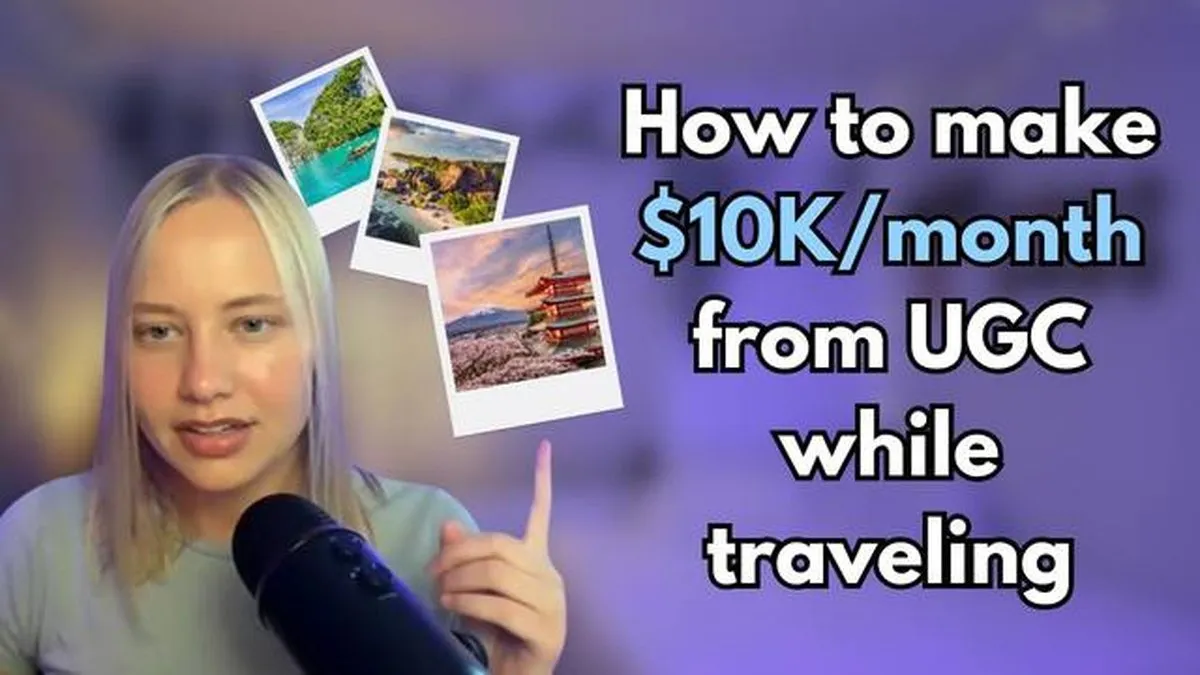
What Is UGC? What I Told 1,000 Digital Nomads
Key takeaways
- UGC (user generated content) is a short video a regular person films on a phone, showing a product in use, that a brand pays for and runs on its own ads, website and social pages.
- The brand posts and distributes the video, so a following is optional. Gloria made her first $5,000 month from content creation with 12 followers.
- Influencer marketing pays for access to your audience. UGC pays for the video itself, and usage rights let the brand keep running it for an extra fee.
- The common formats are testimonials and reviews, problem-solution videos, faceless videos and spokesperson or tutorial videos for software.
- You start with a phone, a microphone and good light, then move from practice videos to a portfolio to pitching brands to setting your rates.
It was 8 a.m. on a Sunday in Minnesota, about 40 degrees outside, and I was live with one of the largest digital nomad communities in the world. Over 1,000 location independent entrepreneurs were on, many of them already running agencies, coaching businesses and e-commerce stores, and I was there to show them what UGC is and how it pays while you travel.
Four minutes in, the host asked if this meant building a TikTok or Instagram profile, or making videos purely to send to businesses. I told them the part that sounds made up, and I said it twice so nobody would miss it.
You don't need any followers. As a content creator myself, the first 5K month, $5,000 in a single month I made from content creation, I had 12 followers. Dead serious. 12 followers.
Gloria Stonelake, 0:04:36
Then I shared my screen and played a video I made for a luggage brand. "Pack with me for Hawaii." An ice blue carry-on, tops and swimsuits going in, the compression straps, the combination lock, the spinner wheels. The brand mailed me that $200 suitcase for free and paid me about $500 for a couple of videos like it.
What the room couldn't see was everything behind the camera. I had rearranged my whole living room into a set to film that one suitcase. That video went past a million views on TikTok, and every one of those views happened on the brand's side. The host stopped me to make sure he had it right.
That wasn't on your channel. You've recorded this, you've sent it to the brand and they have driven a million views to it, right?
Host of the digital nomad community call, 0:10:13
He had it right. You make the video, the brand runs it.
What is UGC?
UGC stands for user generated content. In marketing, it means a short video made by a regular person on a phone, showing a product or service being used, that a brand pays for and then uses to sell.
UGC stands for user generated content. You've seen it before, the video ads or social post on TikTok or Instagram showing someone using a product, showcasing its benefits and making you want to buy the product.
Gloria Stonelake, 0:01:34 (How I Make $10k a Month with JUST My iPhone)
A UGC creator is the person who makes those videos for brands. You script it, film it on your phone, edit it in an app like CapCut and send the file over. The brand can run it as a paid ad on TikTok, post it on TikTok organically, put it on their website or use it in any material that gets someone to buy.
Any company with a product or a service can use UGC: supplements, skincare, beauty, hotels, Airbnbs, software, AI apps, fintech, real estate agents and professional services. When I was in Bali, every video I made was service-based UGC for digital companies, with no physical product to ship.
How is UGC different from influencer marketing?
Influencer marketing pays you to promote a product to your own audience. UGC pays you to make the video, and the brand puts it in front of their audience through their own ads and pages. Your follower count barely matters to that brand, because they are buying the video and the right to use it.
You will get pitch replies that say "You have no audience, how does this benefit us?" I wrote a reply for exactly that email and gave it to our community. This is the core of it:
A totally fair question, and I'm actually glad you brought this up because there's a big difference between UGC (what I offer) and influencer marketing. UGC, or user-generated content, is not about me promoting to my audience. It's about creating content you can use on your platforms ads, website, organic posts, that looks native, authentic, and performs better than polished brand content.
Gloria Stonelake, Skool post, 2025-05-07
My favorite line in that reply: "Think of me as your behind-the-scenes content creator, not a promoter." Then it moves straight to rates, which depend on video type, usage and volume, and offers a quick call. When a brand asks about your audience, explain the difference, then ask for the call.
Money works differently too. Instead of handing your video over forever, you can give the brand usage rights, the permission a brand pays for to keep running your video in its ads for a set period.
You give them usage or leasing rights on your content, if that makes sense. It's kind of like renting an apartment.
Gloria Stonelake, 0:14:17
One supplement company I worked with pays me an extra $100 to $200 every 90 days because they keep running my videos. And when a brand does want the video posted on your own Instagram, that becomes an extra charge on top of the video itself.
What do UGC videos look like?
UGC videos are short, phone-shot marketing videos that make a product feel real to the viewer. On the nomad call I described the main types as product reviews, product testimonials, service videos and problem-solution videos. Every one of them has the same job: help a brand sell.
Here are the formats you will see most:
-
Testimonial or review. You talk about the product as someone who uses it. I messaged an Amazon seller about a pair of glasses I already owned, made a raw testimonial-style video, got paid about $200, and the video went up on their storefront.
-
Problem-solution. You open with a pain point and show the product fixing it. The skincare example in my iPhone video opens with "If you struggle with textured skin or acne scars, this product is 100% for you."
-
Demo or "pack with me." You show the product in use from start to finish, like the suitcase video.
-
Faceless. You never appear on camera. For an Airbnb, that means 10 or 15 shots of the space with a hook written on screen. The Airbnb example I showed on the call got 2,900 likes.
-
Spokesperson or tutorial. You speak straight to camera for a software company whose CEO doesn't want to be the face of the brand, or you turn complicated software into a simple walkthrough.
I build every script on what I call the strategic UGC framework: hook, problem, solution, benefits, call to action. A hook is the first line and first shot, the part that makes someone stop scrolling. The call to action is the closing line telling the viewer what to do next, like "go get this now." I put the framework on my portfolio too, because it shows a brand you have a method.
Why do brands pay for UGC instead of shooting their own ads?
Brands pay for UGC because viewers relate to people who look like them. As I told the room, a video has to hit home for the viewer to buy. The host on the nomad call put it well: a brand-made ad feels like the product is being forced down your throat, and a regular person's video feels authentic.
Cost matters too. A brand shoot means a studio, actors and a whole setup, and UGC moves all of that into a creator's home. My living room became the set for that suitcase video, and I was the actor.
So the bar is a video that sells, and that work starts before you hit record. Before you film, declutter the room, get good light, pick an outfit that fits the part and do your makeup.
The full comparison is in why brands are choosing UGC over traditional ads.
Do you need followers to be a UGC creator?
No. Most brands don't ask you to post UGC on your own feed at all. You send the file to the brand, the brand posts it, and the views land on their account. That is how a video passes a million views on TikTok without ever touching the creator's own profile.
I had 12 followers when I made my first $5,000 month from content creation. You still want TikTok and Instagram handles set up for UGC, because brands check that you are a legit creator before they work with you. A big audience behind those profiles is optional.
The one exception is a brand that asks you to post on your own account. Posting is a separate job, and you charge extra for it. If this is the part holding you back, read whether you need followers for UGC.
What gear do you need to start UGC?
You need a phone, a microphone and a tripod, plus decent light. When someone on the nomad call asked about equipment, I cut it to three things.
Guys, you need three things. Let's just cut it to that. You need three things. You need a good camera. It could be your phone or camera. You need some sort of microphone.
Gloria Stonelake, 0:33:37
-
Phone. An iPhone 11 or newer is fine, and a newer Android works too. I film on an iPhone 15.
-
Microphone. My wireless mic cost about $200 at Target. A $15 clip-on mic from Amazon keeps your audio crisp too.
-
Tripod. It holds the phone so your hands are free. Most videos need one, except travel UGC where you are moving around.
-
Light. Outdoor light does the job. A ring light or softbox is optional.
I edit every UGC video on my phone in CapCut, which is beginner friendly and works on Android.
How do you go from zero to your first paid UGC video?
You pick a few niches, make practice videos, put them in a portfolio, pitch brands and then land the client. That is the path I gave the nomad room.
-
Choose three to five niches. Start with what you already care about. Animal lovers can pick pet brands, outdoorsy people can pick camping, and strong speakers can pick professional services.
-
Make practice videos with what you own. My advice in an older video was to "make your first UGC videos with random objects around your house": a water bottle, headphones, glasses, vitamins. Then do the 7-day UGC challenge below.
-
Build your portfolio. A UGC portfolio is a simple website, like a photography portfolio for your videos. I build mine in Canva. A good base is about seven videos, and I keep roughly three per niche I pitch.
-
Pitch brands. Email them, DM them on Instagram, use creator apps like Backstage, or message Amazon sellers through the "contact seller" option and move the conversation to email.
-
Land the client. Share rates over email or on a call, sign a contract, and give yourself three to five business days to deliver. A full video, scripted, filmed and edited, takes me about 4 hours.
I tell my creators all the time, do the 7-day UGC challenge. Make one video a day for the next 7 days and put it on your portfolio.
Gloria Stonelake, 0:32:35
The catch with the challenge: each day has to be a different niche. Supplements one day, a local hotel the next, a suitcase after that.
Expect a numbers game when you pitch. My estimate on that call was around five positive answers per 100 pitches, which I count as good. The pitch itself stays short: how you found the brand, what you do for brands like them, and an offer to send your portfolio. Pitching brands that few creators contact also raises your odds.
You can even pitch with a finished video. Film the Airbnb you are staying at, then message the host: "Hey, I made a video of your Airbnb." Tell them your normal rate is $200, then offer it for $50 or $100 this time. Paid or not, it goes in your portfolio.
Keep your rates off your portfolio. I share rates over email, in DMs or on a call, after the brand has seen the videos and wants to talk. The full beginner walkthrough lives in how I would start UGC with no experience.
How much does a UGC video pay?
My own rate is around $200 a video. When a brand orders a package, I lower the price per video, so three videos come to $500 instead of $600. That is my number and my experience, and it is no promise of what your first deal will pay.
You break down your rates and my rates are like $200 a video. If they buy a package I'll knock the price per video down.
Gloria Stonelake, 0:23:29 (Full 6 Figure UGC Creator Course)
Before your first call, write down two numbers: your floor and your ideal rate. Mine stays in my head. The lowest I go is $200 a video, unless a brand orders several at once. Usage rights sit on top of that base rate, and they are why my supplement client keeps paying me every 90 days.
Payment works like any freelance job. You sign a contract, deliver the videos in a Google Drive link and send your PayPal. Brands pay me out 5 to 7 days after delivery on a normal deal, and the brand owners I'm close with on WhatsApp sometimes pay me the same day.
In one year of doing this, I took home over $150K from UGC. I still remember when rent was the whole problem.
"Rent was fifteen hundred. My paycheck was two thousand. That left five hundred for everything else."
To set your own numbers, read how much to charge for UGC. For what other creators have reported, see how much UGC creators make.
A note on the numbers
Every dollar figure here is my own result or rate, from the nomad call, my free course or our community. None of it is a prediction of what you will earn. Rates, replies and results vary by niche, brand, skill and how much work you put in.
Frequently asked questions
What does UGC mean?
UGC stands for user generated content. In marketing it means short videos made by everyday people on their phones that show a product being used. A brand pays the creator for the video and then uses it in its TikTok or Instagram ads, on its website or in its organic posts.
What is a UGC creator?
A UGC creator is someone brands pay to film those videos. You work as your own business: you pick your niches, build a portfolio of sample videos, pitch brands, sign a contract and deliver the files. Gloria says brands typically pay out 5 to 7 days after delivery.
What is the difference between UGC and influencer marketing?
An influencer gets paid to promote a product to their own audience. A UGC creator gets paid to make the video, and the brand runs it on its own ads and pages. That is why a UGC creator with no audience can still get hired.
Do you need followers to do UGC?
No. Most brands do not ask you to post the video on your own feed, because they post it themselves. Gloria had 12 followers when she made her first $5,000 month from content creation. If a brand does want it on your account, you charge extra for that.
Can you do UGC without showing your face?
Yes. Faceless UGC uses shots of the product or place with a hook on screen, like a 10 to 15 shot tour of an Airbnb. Gloria's view is that showing your face reads as more authentic and opens up a bigger pool of brands, so faceless leans harder on your filming eye.
About the author. Gloria Stonelake is co-founder of UGC World and Head of Creator Talent. She took home over $150K in one year from UGC, then built the agency brands pay to staff their campaigns with trained creators. Meet the UGC World team.
UGC World is a personal and business finance education and training company. Results described here are the experiences of the named creators and are not typical. Success depends on implementation and effort. We do not make claims about what you should expect to make.

