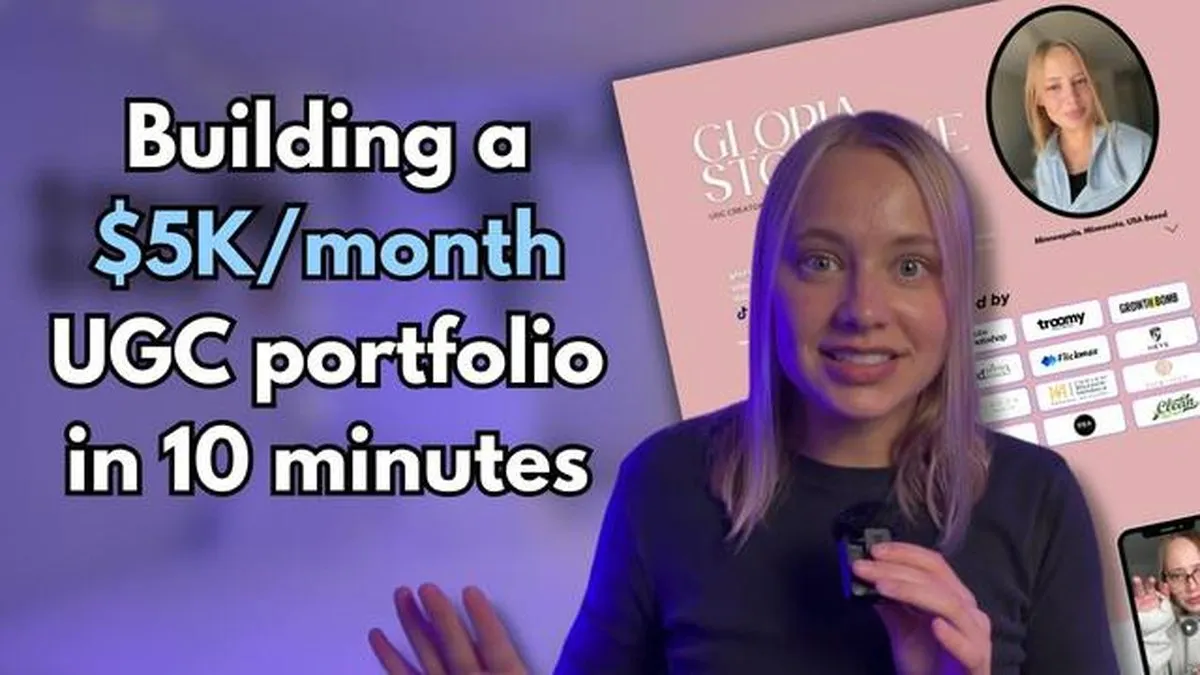
How I Would Build a UGC Portfolio With No Experience
Key takeaways
- A UGC portfolio is a sales page for brands. Every line on it answers one question for the brand: how does this help me?
- Three videos that show you can talk naturally, open with a hook and deliver a clear message are enough to send your first pitch. Five is a strong target.
- Sample videos can come from products you already use at home or software you open every day. Label them honestly and never claim a brand you did not work with.
- Your first video should be a short My Story intro: three paragraphs, read from a teleprompter, with captions and music added in CapCut.
- Keep your rates off the portfolio and end it with a clear way to book a call or email you.
I sent my first real pitch with three videos. One was filmed in my car. Another was shot in my kitchen, lit by the natural light from a window.
The brand responded in 36 hours.
It took me three months to send it. I kept adding one more video, one more product, one more round of edits before I felt ready to put it in front of a brand.
I kept calling it "building my portfolio." What I was actually doing was building a delay I could feel good about.
Gloria Stonelake, Skool post, 2026-03-31
A UGC portfolio with no experience can get a yes. It needs the right pages, a few honest videos and a creator willing to send it before it feels finished.
How do you build a UGC portfolio with no experience?
You build a UGC portfolio with no experience by copying a Canva portfolio template, filling in your name, title, email, location and photo, then adding one video and a way to contact you. UGC means user generated content: short videos real people film on their phone for brands, which the brand then posts or runs as ads. The portfolio is where a brand goes to decide if you can make those videos for them.
In the UGC Games I told complete beginners to start with an MVP, a minimum viable portfolio.
Think of your portfolio like a restaurant menu. It's what your customers look at right away.
Gloria Stonelake, 0:59:02
Here is the exact sequence we followed live:
-
Open the Canva portfolio template link.
-
Press Sign up in the top right corner and continue with Google.
-
Press File, then Make a copy, and you have your own editable portfolio.
-
Fill in page one, then the about me, then put your email on the last page.
A lot of the room finished in 10 minutes. Most creators do not make a portfolio in their whole first month, so one sitting already puts you ahead. Fonts and making it prettier come later. The videos are what a brand is buying, so the videos carry the portfolio.
If you are still at the very start, read how I would start UGC with no experience first.
Build your Canva UGC portfolio like a funnel, page by page
A good portfolio walks a brand from the top of the page down to a booked call, one section at a time. Brands give your portfolio about 5 to 10 seconds before clicking off, so every section gets one job.
To find a layout, go to Canva, search "UGC website," open Canva templates and pick one labeled UGC portfolio website. Press Customize this template. Then fill it in this order, which is the order on my own portfolio, the one that has generated me tens of thousands of dollars:
-
Top page. Your name front and center, your title, a clear photo, your city, state and country, your email linked so one click opens a fresh message, and your social icons linked to your accounts. For the title, write "UGC Creator" plus what you did before: teacher, college student, server. Your photo should show your face plainly, with no hat, sunglasses or filter.
-
Social proof. Logos of brands you have worked with, case studies, reviews, podcasts or magazines you have been featured in. You can get away with having no real social proof here at the start. I've made a full-time income with UGC without any actual insights on mine.
-
Videos. Big, organized and easy to click through. In Canva, open each video and turn off play automatically. It is on by default, and if you leave it on, every clip starts playing at once when someone scrolls.
-
What makes you different. A short list of how you make videos and how you do not. Most creators skip this page.
-
About me. Two to three sentences to start: your background, where you are from and the niches you want to create for.
-
Call to action. Mine says "Let's get started. Next step, book a 15-minute strategy session below," with a link to my calendar and a line telling brands these calls are valuable whether or not they move forward. As a total beginner, your email is enough here.
The rule that ties it together is brand centered. Every fact about you has to explain how it helps the brand.
Brands don't care that you love to travel. They care that you love to travel and you can help them.
Gloria Stonelake, 0:15:12
So "I have a background in sales and marketing" earns its place when the next line tells the brand how that helps you make better content for them. Your UGC creator bio follows the same rule.
Where do sample videos come from when no brand has paid you yet?
Sample videos come from the products already in your home and the apps already on your phone. You film a video about a product the way you would for the brand, put it on your portfolio and pitch that brand with it. Nobody has to hire you first.
When I was asked how a beginner builds a portfolio with nothing in it, this was my answer:
Also, you could just take random products that you use every day in your life without even technically working with the company. You can just make videos around their products.
Gloria Stonelake, 0:35:39
Coach Will gave the same advice on day two of the UGC Games, and he gave the method: take a picture of the product, ask ChatGPT to write you a script for a demo video, film it and post it on your portfolio. He started as a brand owner and has hired over a thousand creators, so this is the brand side talking:
Good content is just good content. If you make good content and you show me the proof of concept in your content, I don't care if you worked with the brand or not, to be honest.
Coach Will, 2:40:49
No physical product to film? Software and AI apps use UGC too. Log into their software on a free trial and film yourself using it.
Going on vacation and staying at an Airbnb worth filming? Take videos of it, put them on your portfolio and pitch the brand.
One line you never cross: do not lie about who you have worked with. Coach Will said it right before that quote, and I say it about the social proof page too. Making a sample video for a product you love is honest. Putting a logo on your social proof page for a brand that never hired you is a lie.
For filming help, see how to film UGC videos on your phone.
How many videos should a beginner UGC portfolio have?
Three videos is the minimum to send your first pitch, and five is a good target. My first real pitch went out with three. Three videos that show you can speak naturally on camera, structure a hook and deliver a clear message are enough to get your first yes. A hook is the first line or first seconds of a video that stops someone from scrolling.
How well the videos match the brand matters more than the count. I keep about three videos per niche. If you pitch one niche and have three videos in it, you are fine. When you pitch several niches, around seven videos is a solid base, and every niche you pitch needs videos of its own.
A five-video portfolio from someone who knows what problem they're solving hits harder than a twenty-video portfolio from someone who just filmed pretty unboxings and hoped for the best.
Gloria Stonelake, Skool post, 2026-03-31
Sort your videos under niche headings like "Skincare" or "Tech," instead of a generic heading like "Organic Videos." Under every video, add a short label with four things: the brand name, the niche, whether it ran as an organic post or a paid ad, and the video style.
Your first video: the My Story intro
Your first portfolio video should be a My Story video: a short talking head where you tell your own story to the camera. A talking head video is you speaking straight to your phone, like a FaceTime call. You need no product for it, and it shows brands your authenticity and relatability.
So if you can't articulate your story, what makes you think brands will let you tell theirs?
Gloria Stonelake, 1:18:55
The script has three paragraphs. Paste the My Story prompt into ChatGPT and it asks you three questions. Type your answers or use the voice feature:
-
What did your life look like before UGC? Walk through your daily routine, your job, the low moments and what drained you most.
-
What moment made you realize you couldn't keep living like that, and what did people around you say when you started to change it?
-
When did you first discover UGC, what did you do first, and what has your life shifted into now?
I answered them live. For question two, I talked about staring at the ceiling after a long Wednesday shift at Walmart and deciding I was done. My parents called me crazy and told me not to quit my job. ChatGPT turned my answers into three paragraphs, and this is how I read the opening on camera:
I used to clock into Walmart feeling like I was suffocating in my own life. Like every shift just dragged me deeper into something I couldn't escape. I couldn't even look people in the eyes because my anxiety was that bad.
Gloria Stonelake, 1:23:08
Then film and edit it:
-
Search "teleprompter" in your app store and download the blue app called Teleprompter, the plain one and not Teleprompter Pro.
-
Press the plus in the top right corner, tap Compose a new script, name it My Story and paste your script.
-
Enable the camera, press the red record button and read it to the lens in one take, knowing you can redo it later.
-
Open CapCut, load the video, tap Captions, then Generate.
-
Go to Audio, then Sounds. For a story video, pick something emotional and ambient, like piano, and turn the volume down.
-
Export it, upload it to your Canva portfolio and switch off play automatically.
Sophia, one of the creators I showed in the UGC Games, whipped out her phone and put music and captions on hers. In it she tells brands what makes her stand out: she used to be a competitive figure skater.
Ryan, 20, from Australia, told the story of being stuck in a law degree he never wanted to finish. Orr, 25, talked about selling art at conventions at 14 and backpacking across Asia, and said that one month in she had four brand deals.
Your first one does not have to be perfect. Pick up your phone and talk to the camera like it is a FaceTime call. For the editing side in more detail, see how to edit UGC videos in CapCut.
What I fixed in Ricky's portfolio in one live call
The biggest fix in a beginner portfolio is matching it to the brands you pitch. When I tore down Ricky's portfolio live, she had been a UGC creator for about a month. She had modeled for 10 years and started in TikTok Shop, and every paid partnership she had booked was clothes and fashion. What she wanted was tech brands.
The top page was strong: name, what she does and who she is, big and clear, with location and email. Here is what I told her to change:
-
One clean photo. She had two pictures stacked on top of each other and a shot in a cowgirl hat. Western brands were not her target, so the hat photo came off.
-
Logos in frames. Each brand logo on a white background, all the same size, in neat rows.
-
Tech videos for tech brands. Her app video was her talking over a screen recording. I told her to show herself walking through the app, add captions, use a microphone to kill the echo and follow the two second rule: a new element, background or B-roll clip every two seconds.
-
An about me that points at tech. Hers led with 10+ years in the beverage industry and a cosmetology license. Keep it, and add a line about tech.
-
Niche headings. Replace "Organic Videos" with the niche name and label every video.
-
A real button. Her "Let's connect and collaborate" text needed to become a link brands click to book.
I put it to her this way: I'm not going to go to Chick-fil-A and ask for a hamburger. A software brand opening your portfolio wants software videos.
If they don't like your videos, they're not going to buy your videos no matter how much social proof that you have.
Gloria Stonelake, 0:13:10
For a portfolio that is live but not booking deals, read my UGC portfolio tips.
Should you put your rates on your UGC portfolio?
Leave your rates off your portfolio. Creators who put their rates on the portfolio and do the whole deal over email are the ones stuck with $200 collabs and no monthly retainers. A retainer is an ongoing monthly deal where a brand pays you for a set amount of content every month.
Do not put your rates on the portfolio. That's the biggest misconception. That's not how you make sales.
Gloria Stonelake, 1:12:47
I tell a brand my rates by DM or email, or walk them through my rates on a call. The portfolio's job is to start a relationship, which is why mine ends with a call booking link. Most UGC creators do not offer a call, and brands love to book one.
Preparation or procrastination? Send it at three
Once you have three videos, a top page and a way to contact you, send a pitch. Anything you add after that point is a choice to wait.
The perfectionism you're calling "preparation" was really just the most socially acceptable form of procrastination available to you.
Gloria Stonelake, Skool post, 2026-03-31
When I started, rent was fifteen hundred. My paycheck was two thousand. That left five hundred for everything else. Three months of "one more video" was three months of pitches I never sent.
Your checklist for today:
- Copy a Canva UGC portfolio template and fill in page one
- Film your My Story video and add it
- Make two sample videos with products or apps you already use
- Write two to three brand centered sentences for your about me
- Put your email at the bottom
Then send it. My post on how to pitch brands for UGC shows the first email I would write. The portfolio gets better by doing the job.
Disclaimer: The stories and numbers in this post are what specific creators shared about their own experience. They are not a promise of what you will earn. Results depend on your work, your niche and the brands you pitch.
Frequently asked questions
Can I make a UGC portfolio with no brand deals?
Yes. Brands buy the videos, so the videos carry the portfolio. Make sample videos with products you already use at home or apps you use every day, and add logos and case studies later as real work comes in.
How many videos should a beginner UGC portfolio have?
Three is the minimum to start pitching one niche, and five is a strong target. If you pitch several niches at once, aim for around three videos per niche so each brand sees work that looks like their product.
Should I put my rates on my UGC portfolio?
No. Gloria calls it the biggest misconception in portfolios. Talk rates by email or DM once a brand is interested, and use the portfolio to get them on a call or into your inbox.
What is a My Story video for a UGC portfolio?
It is a short talking head video where you tell your own story in about three paragraphs: where you were stuck, the moment you decided to change, and how you found UGC. It shows a brand you can tell a story on camera before they trust you with theirs.
Do I need a website for my UGC portfolio?
Gloria builds hers as a Canva website. Search "UGC website" in Canva templates or copy a UGC portfolio template, fill in your name, title, email, location and photo, and add your videos. To host it as a website with your own domain, she says you need a paid Canva account.
About the author. Gloria Stonelake is co-founder of UGC World and Head of Creator Talent. She took home over $150K in one year from UGC, then built the agency brands pay to staff their campaigns with trained creators. Meet the UGC World team.
UGC World is a personal and business finance education and training company. Results described here are the experiences of the named creators and are not typical. Success depends on implementation and effort. We do not make claims about what you should expect to make.

