UGC Portfolio Tips: How I'd Fix One That Isn't Booking Deals
Key takeaways
- Page one of a UGC portfolio should show your photo, a clear statement of who you help and how, and the brands you have worked with. Your about-me section belongs at the end, right before you ask a brand to book a call.
- Gloria says brands spend about 3 seconds on a portfolio, so put your newest and best videos at the top and label each section by niche (skincare, tech, fashion) instead of a generic "UGC videos" heading.
- Your portfolio has to match the deal you are pitching. A portfolio full of CPM (pay per view) videos does little to win a traditional deal where a brand pays a flat rate for a demo video.
- Leave your rates out of your portfolio and wait for a brand to say yes before you send it. The portfolio's only job is to prove you can do the work.
- If your current videos are weak proof, film new ones fast. In Olivia's audit the goal was seven new tech videos in seven days, built around apps she already uses.
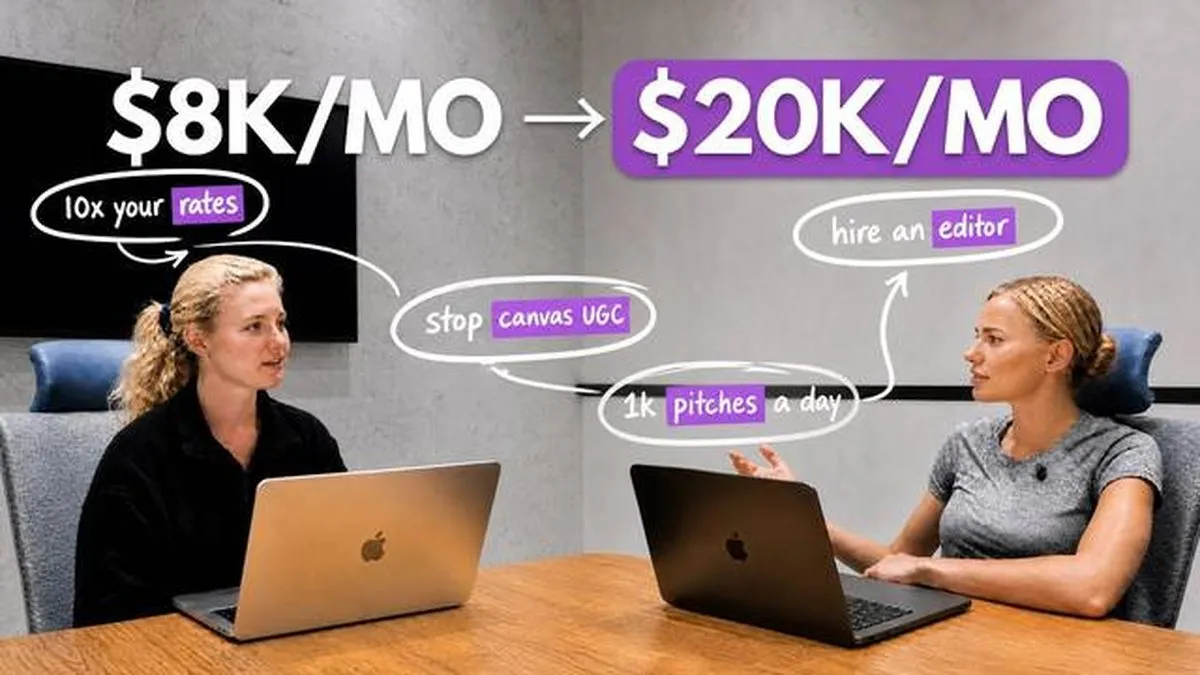
Olivia flew from Los Angeles to Europe to sit down with me in person, and she paid for the flight with her content money. Halfway through our session I asked to see her portfolio, and she said, "This is like the most, it's so cringe."
It was a Canva file with text over her face, a background that confused me, pages you had to click through one by one, and low edit videos made for a different kind of deal.
I took it apart live on camera. These UGC portfolio tips come from that audit, a second audit with a creator named Nicole, and what I have posted for my students, as someone who reviews portfolios for students and for brands all the time.
Olivia is 24, a comedian, and she spent a few years working in tech before she went all in on content. When we met she was running high volume tech campaigns, eight videos a day across her accounts, and she told me last month came in at over $6K.
She wanted bigger, slower deals: a higher base pay per video, and monthly retainers, where a brand keeps paying you every month for a set number of videos. Those brands would judge her on that portfolio first.
Olivia left with a week of work, starting with seven new tech videos in seven days. Run the same fixes on yours tonight.
What should go on page one of a UGC portfolio?
Page one should answer one question for a brand: who do you help, and how. Put a clear photo of yourself there, one line describing the content you make, and the brands you have worked with.
Quick definition. UGC (user generated content) is a short video you film on your phone, showing a product in use, that a brand pays for and runs on its ads and social pages. Your portfolio is the page of examples you send a brand to prove you can make that content.
I told Olivia to treat page one like a modeling portfolio. Brands need to see what you look like, so take the text off your face.
Then write the same statement you use in your Instagram bio: what kind of brands you help and what you bring them. For Olivia that meant tech brands and funny, comedic demos. If you have not written that statement yet, my guide to writing a UGC creator bio walks through it.
The part that surprised her was where I moved her about-me section.
Frankly, brands don't care who we are.
Gloria Stonelake, 1:06:43
She asked if that meant the end of the portfolio. Yes, right before you tell them to book a call.
At the start, a brand only wants to know one thing: can you do the work? Your story is lovely. Put it after the proof.
Move your about-me to the last page today.
Why do brands leave a UGC portfolio in seconds?
Brands spend about 3 seconds on a portfolio, so anything that slows them down costs you the deal. The two biggest slowdowns are old videos on top and sections nobody can scan.
I posted this for my students in October because I kept seeing it on our group calls:
brands spend about 3 seconds on a portfolio. most of u have ur very first videos up top and ur best recent work at the bottom, so they're judging u on the version of u from months ago and leaving before they see how much u've grown
Gloria Stonelake, Skool post, 2026-10-23
The fix: newest and best at the top. Every time you make something better, move it up.
Section labels matter just as much. A lot of creators title everything "UGC videos." A skincare brand that has to scroll past tech and fashion clips to find one skincare video tends to leave before it gets there. Label your sections by niche instead, so each brand sees its own category straight away.
I see the cost of this from the other side, because I place creators into brand deals from my network. When someone applies for a skincare campaign and their skincare videos sit at the very bottom, I am clicking forever.
Your portfolio 15 pages long, all I need is 10 pages tops, right, and I need skincare right there on top.
Gloria Stonelake, 1:13:05
Nicole had a related problem. She had a section labeled app demos, and the videos in it did not really demonstrate the app. They were viral style reaction videos. I told her to label those CPM and build a separate app demos section with videos that actually demonstrate an app.
Do fonts and layout matter in a UGC portfolio?
Less than your videos do. The quality of your videos and the results behind them decide whether a brand books you, and fonts, colors and backgrounds come a distant second.
I said this to Olivia while looking at her messy layout. If you have amazing videos, a brand will buy from you even if the text and colors are a mess. The layout still matters because it signals how careful you are. A sloppy portfolio makes a brand wonder what else you will mess up.
Results go everywhere you have them. I compared it to a cake decorating shop. You would never walk into one with zero decorated cakes on display, and a brand will not hire a creator with zero proof on the page. For Olivia, that meant keeping her high volume tech videos with screenshots of the views, as case studies, until she had results from traditional brands.
Nicole's views were her strongest asset, with videos in the millions. I still told her to shrink the results box to half the page, circle the highest viewed videos, and keep only her top seven. A brand gets it after a few.
One warning about "best." I once had a video in my portfolio I was really proud of. High production value, cinematic lighting, great editing. I kept sending it and kept getting passed over. A marketing director finally told me why: it looked too polished, like I would make their ads look like ads.
Removed that video. Replaced it with something I'd filmed in my kitchen with natural light. Messy background. No fancy transitions. Started booking more work immediately.
Gloria Stonelake, Skool post, 2025-12-08
If you are still filming your first pieces, here is how I would build a UGC portfolio with no experience.
Does your UGC portfolio match the deal you want?
Your portfolio has to show the type of video the brand is buying. If you pitch traditional deals with a portfolio full of CPM videos, the brand sees nothing it can use.
Two definitions. A CPM campaign pays you per thousand views, sometimes with a small base rate per video, so you film a high volume of videos built to go viral. Traditional UGC deals pay a flat rate per video, and the brand runs that video as an ad or keeps it on its own pages to sell to people already shopping. If CPM is new to you, this explainer on CPM campaigns covers how they pay.
Nicole makes CPM content and does it well. She had also told me she wanted a 50-50 split: $200 flat rate videos on one side, $10 CPM videos with bonuses on the other.
That's not like a bad thing, but your portfolio just shows CPM UGC.
Gloria Stonelake, 0:47:22
Brands looking for traditional content had probably landed on her page and passed. There were no tech demos, no videos showing the product, no story about how a product changed her life.
I showed her a tech demo I made for AI Apply: about 40 seconds, problem, solution, then a demonstration of the app solving it. That brand paid me over $250 for it, and it took me about two hours.
Olivia had the same gap from the other direction. We had just written her a pitch about funny, comedic content for tech brands. Her portfolio showed separate low edit tech clips and comedy clips.
A brand that replies to that pitch and opens that portfolio sees two different creators. The pitch and the portfolio have to tell one story.
If your pitch and your portfolio tell two different stories, a coach can line them up with you.
How many new videos do you need to fix a weak portfolio?
Enough to replace your weakest proof with videos that match your pitch, and fast. For Olivia the target was seven new tech videos in seven days, with six as the floor.
We need to completely flip the portfolio.
Gloria Stonelake, 1:12:00
Her old videos stayed. I told her to move them to the end as proof of concept, then fill the top with new work aimed at the brands she was pitching.
To pick the products, I asked her which software she cannot live without. Claude came first.
Then I asked about something that changed her life, and she lit up about SkipLagged, a travel site that finds cheaper flights. The second she said it, the passion was obvious. That is the video to film first.
A few filming notes from the same audit:
-
Film products you already use. Pick your top three apps or products and make several videos for each, in different formats, such as a skit or a green screen software video.
-
Combine your strengths in every video. Olivia asked if every video should mix comedy and tech, and my answer was yes. Split them into separate sections and a brand sees someone who makes comedy videos or tech videos, which is a boring mechanism. Make each one a funny tech demo.
-
Explain it like the viewer knows nothing. Her trading app video lost me, and I review UGC for a living. If a brand owner cannot follow it, the video is too niche.
-
Keep the camera steady. Use a tripod or a windowsill for selfie style shots instead of a shaky arm.
Then keep going. A lot of creators plan to update their portfolio every three months.
I'm like, no, no, no, no, no. You update that thing once a week.
Gloria Stonelake, 1:05:39
While you rebuild, make it one page a brand can scroll. The thing I hate most as someone who reviews portfolios for students and for brands is clicking from page to page. Connect a domain so it lives at a real web address.
Should you put your rates in your UGC portfolio?
No. Rates in a portfolio make a brand judge your cost before it understands your value, and plenty of them close the tab right there.
I wrote about this back in July 2025. Picture a price like "$800/video" printed under your work. The brand scrolls, sees the number, calculates the budget impact, and leaves. You never get the chance to show what you can do or learn what they need.
The portfolio should answer "Can this person deliver results?" and nothing about whether a brand can afford you.
Your portfolio gets you the meeting. The meeting gets you the money.
Gloria Stonelake, Skool post, 2025-07-16
Save pricing for the conversation, where you can hear their goals and budget and tie your number to results. When you get there, my guide on how much to charge for UGC helps you pick it.
Should you send your portfolio before a brand asks for it?
No. End your first pitch with a question and send the portfolio once the brand says yes.
Attaching your portfolio link to the first email feels helpful. It skips the small yes that gets a brand leaning in. I compare it to dating: you ask someone to coffee before you plan a weekend away. When a brand has said "yes, show me," it opens your portfolio already curious.
There is a technical reason too. Emails with links land in spam more, especially from a free email address and especially to someone you have never emailed before. Some of those emails never arrive at all.
So close with something like "Would you like me to share a few examples?" or "Want me to send over my portfolio?"
Wait for the yes. Then send.
Gloria Stonelake, Skool post, 2026-01-21
The pitch I wrote with Olivia ends the same way. Once a brand says yes and asks for examples, the portfolio becomes the second half of the pitch, which is why the two have to match. If brands are going quiet before they ever ask, read why brands aren't replying to your UGC pitch.
Fill in your Backstage skills section
If you are on Backstage, the skills section on your profile controls whether brands see you at all. Fill it in completely.
Backstage is a casting platform that started with actors and now books content creators too. I only recommend it once you have six solid videos in your portfolio and have landed your first paid brand deal. If that is not you yet, skip this section for now.
A lot of my students signed up and skipped the skills section because it looks optional. Brands use it to filter who they see. Leave it blank and you never appear in their search, no matter how good your work is.
It takes about 10 minutes. Rate each skill all the way to three dots, not one or two. Rating yourself low discredits work you are proud of.
A UGC portfolio tips checklist to run tonight
Run this on your portfolio tonight:
- Page one shows your face clearly, who you help, the content you make and the brands you have worked with
- Your about-me section sits at the end, right before you ask for a call
- Sections are labeled by niche, and each label matches the videos underneath
- Newest and best videos are at the top
- Results are on the page, in a box that takes up no more than half of it
- The videos match the type of deal in your pitch
- No rates anywhere
- One scrollable page with a domain connected
- You updated it this week
Olivia's own takeaway is the reason I do these audits on camera.
Telling me my portfolio sucks honestly, that just helps a lot.
Olivia, 1:31:27
None of this is a talent problem. These are small technical fixes, and brands notice them fast.
Disclaimer: The creator results in this post are what those creators told us about their own businesses. They are not a prediction of what you will earn. Results depend on your skills, effort, niche and the brands you work with.
Frequently asked questions
What should a UGC portfolio include?
Start with a clear photo of you, one line on who you help and what kind of content you make, and the brands you have worked with. Then add your videos grouped by niche with your newest and best on top, any results such as view counts or case studies, and your about-me section near the end.
Should I put my rates in my UGC portfolio?
No. Gloria's view is that a price with no context makes a brand calculate its budget and close the tab before it sees your value. Save pricing for the conversation, where you can learn what the brand needs and position your rate against results.
How often should I update my UGC portfolio?
Gloria tells creators to update it once a week with new videos. Every time you make something better than what is already there, move it to the top so brands judge you on your current work.
Should I use Canva or a website for my UGC portfolio?
The software matters less than the setup. Gloria says Canva makes it easy to end up with an unprofessional layout if you pick the wrong template, and she dislikes portfolios that make brands click from page to page. A single page a brand can scroll, with a domain connected, is what she recommends.
Should I send my portfolio in my first pitch email?
Gloria recommends ending your first pitch with a question such as "Would you like me to share a few examples?" and sending the portfolio once the brand says yes. A brand that asked for it opens it, and emails with links from a sender they have never heard of tend to land in spam.
About the author. Gloria Stonelake is co-founder of UGC World and Head of Creator Talent. She took home over $150K in one year from UGC, then built the agency brands pay to staff their campaigns with trained creators. Meet the UGC World team.
UGC World is a personal and business finance education and training company. Results described here are the experiences of the named creators and are not typical. Success depends on implementation and effort. We do not make claims about what you should expect to make.

