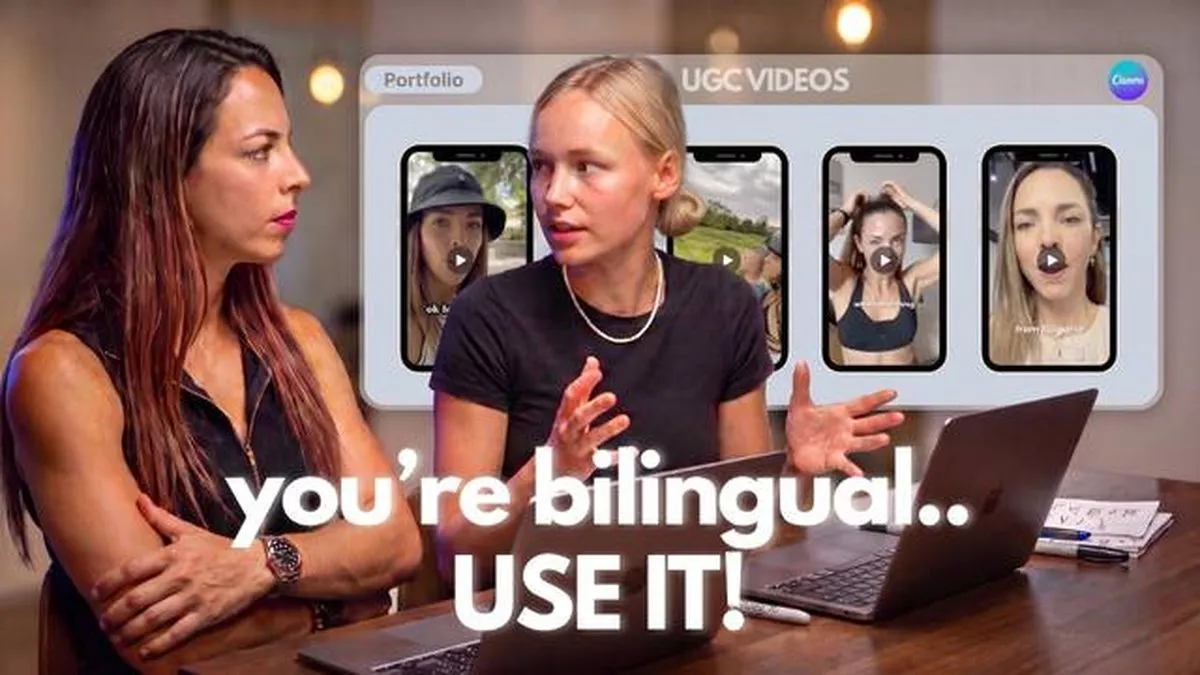
The 10 UGC Video Mistakes I Look For When I Audit a Creator
Key takeaways
- Most beginner UGC video mistakes are foundation mistakes: no face, no mic, dead space, a flat customer service voice, creeper angles, and a product that shows up too late.
- Run a 15-second test recording before every shoot. A badly connected mic adapter cost one creator the audio on a whole video, and a quick test catches that before you film.
- Get to the point of a UGC video inside the first 10 seconds, or build it straight into the hook. A 60-second video that reaches the product halfway through is too long.
- When a video gets views and still fails to convert, look at the format first. Direct talking head videos are wearing out, and whiteboard, interview and podcast styles feel less like an ad.
- Track every post in a sheet (hook, format, angle, views, saves, shares) and review it every 3 days so the same mistake never shows up twice.
Paloma was four weeks into UGC when we sat down for a live audit of her business. Eighteen minutes in, I pulled up my bad vs good habits list, read out "films without a microphone," and stopped on one of her videos. It had no microphone audio.
The audio was not working.
Paloma, 0:18:02
She had gone back and checked. The adapter on her phone was not connected properly. One badly connected adapter cost her the audio on that video.
Content was already her world. She had spent two years as a social media manager for personal trainers and nutrition clients, she was born in Spain to Colombian parents, and she had lived in Switzerland and Australia before going all in on her own business as a digital nomad. Her first goal was $1,000 from UGC alone.
She was good at the hard parts. Her editing used what I call the two second rule, where something new hits the screen every two seconds. The lighting on her fitness video was wonderful. She never slipped into the customer service voice.
The small mistakes were hiding in the foundations. That matters most in month one, because if you learn the foundations wrong, they are very hard to unlearn.
What are the most common UGC video mistakes beginners make?
The most common UGC video mistakes are foundation mistakes: hiding your face, bad audio, dead space, a flat voice, bad angles, and a product that shows up too late. UGC (user generated content) means short videos you film on your phone that brands pay for and post on their own pages and ads. You don't need followers to do it, so brands judge you on the video itself.
I compiled this list into a chart for my students. Here is every bad habit next to the good habit that replaces it:
-
Faceless videos. Show your face in every video. Without it there is no trust, and the video reads like a random actor or AI.
-
No microphone, or audio so soft it's barely audible. Record clean audio with a mic in every single video.
-
Dead space. Cut every beat so something new happens every 2 seconds.
-
The customer service voice. Talk like a real person, with natural energy, conviction and a smile.
-
Creeper shots. Film parallel and centered, product on the grid, shoulders in frame on talking heads.
-
Telling instead of showing. Show the product in use, in the real places it lives.
-
Burying the product. Hook in the first 5 seconds with your best visuals and headline up front.
-
Breaking caption rules. Keep captions clean, classic white text following the 30% rule.
-
Listing features. Sell benefits by attaching what each feature does for the viewer.
-
Obsessing over effects. Sell one clear emotion and match the music, footage and pacing to it.
Paloma already had most of these down. Audio caught her first. Showing instead of telling was the one she said she needed to work on.
How do you fix bad audio in a UGC video?
Record a 15-second test before every shoot, play it back, then watch the finished video with earbuds in before you post. Audio is the first mistake on my list of what kills UGC performance, and we review hundreds of videos on the agency side.
Bad audio makes viewers physically uncomfortable and they scroll instantly, even if they can't explain why.
Gloria Stonelake, Skool post, 2026-07-17
You can post super low quality footage with clean audio and it can still go viral. Flip that and the video is dead on arrival.
The test is what would have saved Paloma's video. It feels boring, and it takes 15 seconds.
Always do a test.
Gloria Stonelake, 0:18:35
Three more checks to run every time:
-
With earbuds in, ask: are both ears working, and is the volume balanced?
-
If you use a Rode style mic (or any mic), turn stereo ON and mono OFF in the app. Stereo plays sound in both ears. Mono plays it in one ear, which feels uncomfortable to viewers.
-
If you film close to your phone, try the phone mic. It can sound more natural.
My guide on how to film UGC videos on your phone walks through the full setup.
How do you get rid of dead space and the customer service voice?
Cut every pause, um and mistake, then deliver your lines the way you would talk to a friend. Dead space makes a video feel scripted. The customer service voice is a polite, flat, salesy delivery with no smile and no energy.
I call the rule behind this Value Per Second. Every second of your video has to give the viewer something.
When you review your edit, ask this about each second: is this entertaining or educating? If the answer is no, cut it. You are competing against creators who cut every one of those pauses out, and dead space kills retention (how long people keep watching). That one habit alone can add hundreds of views per video.
Paloma was already good at this. If you only fix one delivery habit this week, smile and talk like you mean it. For the editing side, my walkthrough on how to edit UGC videos in CapCut shows how to cut every beat.
How should you film the product in a UGC video?
Film parallel and centered, with the phone level with the product, and show the product working while you talk about it. A creeper shot is the opposite: the camera angled down at the product instead of parallel and centered.
Telling instead of showing was Paloma's weak spot. In one of her videos she talked to the camera for a while, then showed the product, then went back to talking to the camera.
No, no. Why can't you show and tell? Come here. Look at this.
Gloria Stonelake, 0:19:05
Paloma got it right away. When you show the product working in real life, the viewer feels like they are there with you. The question in their head becomes "how can she fake this? This is so real." That is what sells.
With an app or a tool, that means zoomed in visuals so viewers can follow every step on screen. On her Metricool video (a scheduling tool for content creators), I wanted her physically scheduling something in the app, or a B-roll shot of her reacting to it.
How fast should a UGC video get to the product?
Get to the point in the first 10 seconds, or build it straight into the hook. A hook is the opening line and visual of your video, the part that makes a stranger stop scrolling.
Paloma's fitness video showed how easy this is to miss. It ran over a minute. She talked about running, about being a digital nomad, about visiting her family, and the bracelet she was promoting showed up around the middle.
It's too long. way too long.
Gloria Stonelake, 0:24:39
A regular video gets about 20 seconds to reach the point. In UGC, you get 10. Paloma watched her own footage back and saw three videos in one, because she was covering three different topics.
The fix is a five-step script: hook, problem, solution, benefits, call to action. For the bracelet, the problem was one she had already said out loud: she was running just to run and had no idea if she was improving.
Her Metricool video had a hook problem. It opened with "I run a digital marketing agency," a hook about her. I rewrote it on the call to lead with the result:
I'm a content creator and this tool completely changed my life because it schedules 241 pieces of content for me in every single week.
Gloria Stonelake, 0:13:54
The exact number changed between versions on the call (115 pieces in one version, 241 in another). What matters is the shape: what the tool does and how much time it saves. Then add how little effort it took, like "it only took me an hour to set up," and the viewer sees the value before the backstory starts.
Two more things I told her:
-
My highest performing videos land around 45 to 50 seconds instead of 60. Cutting 10 or 15 seconds forces a tighter script.
-
Narrow your hook to the exact person. "Hey, I'm a content creator" is broad. Opening on "I struggle with this problem" is a narrowed down hook.
Test double hooks too: a spoken hook plus a text headline on screen at the same time. I break down the four hooks I stack (visual, text, caption and audio) in how I write UGC hooks.
How to fix captions, feature lists and over-edited videos
Keep captions clean and high enough that they never cover the like and share buttons. Captions that sit too low, fancy fonts and over-animated effects all break the rules on my chart. I showed Paloma the red no-go zone on screen and told her the captions should never touch it.
Features are the second trap. A creator lists ingredient after ingredient and never says what any of it does for the viewer. Attach a benefit to every feature you mention.
The last mistake on the list is the sneakiest. Beginners obsess over graphics and effects while the storytelling underneath stays weak. Pick one clear emotion for the video and match the music, footage and pacing to it.
Paloma did a good job here. She still said the reminder helped, because with this many details to track, it is easy to forget one.
Why are my UGC videos not converting even when they get views?
When a video gets views and still fails to convert, check the format before you touch the script. I was on a call with a campaign lead for the agency breaking down exactly this problem for one creator.
it was not the script. it was not the hook. it was not even the editing. it was the FORMAT. and once we changed that, everything shifted.
Gloria Stonelake, Skool post, 2026-07-15
Direct talking head videos (you staring straight into the camera the whole time) are wearing out. Viewers feel talked at, their brain flags it as an ad, and they scroll.
Here is what to try instead:
-
Look slightly off camera. It feels like a movie scene, like the viewer is watching you live in your world.
-
Use a whiteboard. We grew up watching teachers at whiteboards, so the brain goes into learning mode. A $2 whiteboard from the dollar store works. Write your hook on it before you press record, and never start with a blank board.
-
Signal authority. One video on that call beat every other creator on the same campaign because of how the creator showed up in the first two seconds. Think a blazer, pulled back hair, a serious but warm tone. Before your next shoot, spend five minutes on your background, outfit and energy, and change one thing.
-
Film interview and podcast style. Content that looks like a camera just happened to be there lowers people's guard. Grab a friend, go outside, and film ten interview clips in two hours.
-
Define the enemy. The nine to five, the system, people saying you can't make money online. Write the villain down before you script, and make it clear in the first ten seconds, because tension creates watch time.
Then pull up your last five videos, find the one with the most saves and shares, and study why it worked. For more formats to test, see my list of UGC video ideas brands pay more for.
Six system mistakes that keep your UGC views stuck
Once your foundations are solid, the mistakes move from the video to your system. These are the ones I see on repeat when we review CPM videos on the agency side. A CPM campaign pays creators based on views.
-
Filming without a script or a hypothesis. Script it fully, even if you go off script while filming. Then write down why the video will work: the hook, the angle, the audience.
-
Not swiping properly. Swiping means studying viral videos to model what works. Put the top creators in your niche next to your own content and list the differences in lighting, music, sound effects and graphics.
-
Quantity over quality. Pumping out 20 rushed videos a day is a losing game. Crack quality first, then scale volume.
-
No tracking sheet. Every post goes in a spreadsheet: date, platform, link, hypothesis, format, angle, views, save rate, share rate, outcome, and what you would redo. Review it every 3 days.
-
Letting small problems linger. A broken mic setting can quietly kill your videos for weeks. Paloma's loose adapter is exactly this. Solve it the day you spot it.
-
Pitching forever instead of refer, renew, resell. Ask current clients if they know other brand owners, and become the top creator on the account so renewing you is easy.
Five videos that each pull 50k views beat twenty that pull 200.
Gloria Stonelake, Skool post, 2026-07-17
Save rate and share rate (the share of viewers who save or share your video) are the most valuable numbers in that sheet, because they prove your video had real value.
How to audit your own UGC videos today
Pull up your last five videos and run them against the list, one video at a time. That is what I did with Paloma, video by video.
Here is the checklist:
-
Is my face in the video?
-
Did I play back a 15-second test, and is the audio clean in both ears?
-
Is there any dead space, any um, any pause I can cut?
-
Do I sound like a person or like customer service?
-
Is the camera parallel and centered?
-
Am I showing the product in use, in a real place?
-
Does the point land in the first 10 seconds?
-
Are my captions clean and clear of the buttons?
-
Did I attach a benefit to every feature?
-
What is the one emotion, and does the music match it?
-
How many saves and shares did it get, and why?
Then update your portfolio. Paloma had five finished videos and only four on her portfolio. I told her to update it every Friday and land on six, because the portfolio is the work we send to brands. My UGC portfolio tips go through the rest of that fix.
To fill it, I gave her a 7-day challenge: seven UGC videos in seven days. Run the checklist on every one.
Disclaimer: Results described here belong to the people who shared them. Every creator's results depend on their own work, niche and market.
Frequently asked questions
What are the most common UGC video mistakes?
The ten on Gloria's chart are faceless videos, no microphone, dead space, the customer service voice, creeper shots, telling instead of showing, burying the product, broken caption rules, listing features, and obsessing over effects instead of the story. Each one has a direct fix, like showing your face, filming parallel and centered, and hooking in the first 5 seconds.
Why are my UGC videos getting views but not converting?
Check the format before you rewrite the script. On an agency call about exactly this problem, the fix was the format: direct talking head videos feel like an ad, so viewers tune out. Looking slightly off camera, using a whiteboard, or filming interview and podcast style clips makes viewers feel like they are discovering something real.
How long should a UGC video be?
Gloria's highest performing videos land around 45 to 50 seconds instead of 60. Whatever the length, get to the point in the first 10 seconds, or build the point straight into the hook.
Do I need a microphone for UGC videos?
A good UGC creator records clean audio with a mic in every video. If you use a Rode style mic, set it to stereo in the app so the sound plays in both ears, and watch the video with earbuds in before you post. If you film close to your phone, the phone mic can sound more natural.
About the author. Gloria Stonelake is co-founder of UGC World and Head of Creator Talent. She took home over $150K in one year from UGC, then built the agency brands pay to staff their campaigns with trained creators. Meet the UGC World team.
UGC World is a personal and business finance education and training company. Results described here are the experiences of the named creators and are not typical. Success depends on implementation and effort. We do not make claims about what you should expect to make.

