CPM vs Flat Rate UGC: Why I Tell Beginners to Take the CPM Deal
Key takeaways
- A flat rate pays a set fee per video. A CPM deal pays a lower base per video plus bonuses for every 1,000 views, so the upside grows with performance.
- Gloria's rule: her advice on negotiating and premium pricing applies after a creator hits a first $1k month. Before that, she points beginners to CPM for reps, proof and portfolio pieces.
- On her Cloud9 account, Gloria says 1 in 10 videos went viral. Her answer to a 10% win rate is to iterate on the winner instead of ideating something new.
- Olivia, a 24-year-old who left an in-person tech job, started on one CPM campaign while still employed and says her first full month after quitting was over $5K.
- Flat rate and retainer work makes more sense once brands approach you with offers you can negotiate. Even then, Gloria says retainers are only 25 to 30% of her own income.
Olivia was 24, living in Los Angeles, and working an in-person tech job she couldn't stand. She wanted to do comedy. Instead she spent her days making small talk about the weather.
In tech, I feel like you kind of just have to be an NPC every day.
Olivia Stevermer, 0:00:00
She gave herself until her August birthday to be self-employed, and she had a number in her head: "I think 5k, I would probably quit my job."
Her first move is the one I point beginners to in the CPM vs flat rate UGC debate. She started on one CPM campaign on the side, still working her nine to five, because high volume tech content had "a lower barrier to entry." She said being on one campaign with a full-time job made it "that really annoying thing you don't want to do."
Then she learned to batch. She learned to swipe formats that were already working, and she started using those formats across more than one campaign.
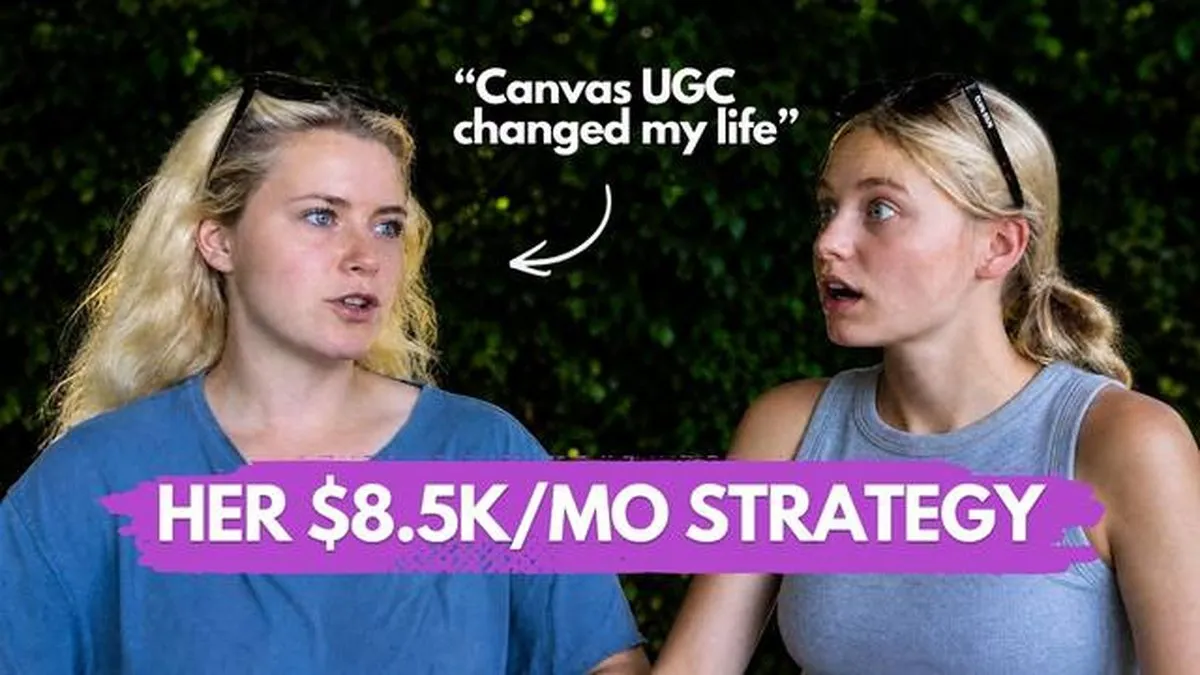
By the time she sat down for this interview in Greece, she had already quit. She said her first full month was over 5K, the next was over six, and the current month should be over eight.
I tell every creator under $1k a month to start where Olivia started. Here is why, and when a flat rate becomes the better deal.
CPM vs flat rate UGC: what is the difference?
A flat rate UGC deal pays you one set fee per video. On a CPM deal, you get a lower base per video, then a bonus for every 1,000 views that video gets. The CPM part is the bonus paid per 1,000 views.
UGC, or user-generated content, means short videos you film on your phone for a brand to post or run as ads. The deal type decides how you get paid for them.
Olivia explained the split in plain words:
So CPM is a lower rate per video but then you have view bonuses so for traditional ugc you can make a few hundred dollars even thousands... but it's a lot of pitching it's just a different game
Olivia Stevermer, 0:03:53
On a CPM campaign, she said, you have a video for every day per brand. In a June post to our community I put numbers on it: the CPM base sits around $15 to $50 a video, compared to a traditional rate of around $150 to $300. Expect a lower base, with unlimited upside once you get good.
Olivia's videos for tech brands run 30 seconds to a minute. She shows the product in the real world in a creative way, with the product featured or saved for the end, instead of a straight "I use this to do X" demo.
The mechanics of thresholds, caps and base rates are in how CPM campaigns pay. For a full definition with examples, start with what a CPM campaign is.
Why I tell creators under $1k a month to start with CPM
Under $1k a month, you need volume, proof and portfolio pieces more than a higher number per video. CPM gives you all three because you post every day.
Some accountability from me first. I talk a lot about premium pricing and not letting brands lowball you, and I stand by it. Without context, though, that advice makes beginners less money. So I wrote this to our community in April:
everything i say about negotiation and premium pricing applies after you've hit your first $1k/month.
Gloria Stonelake, 2026-04-28
When you are brand new, you are a beginner, and beginners in any field aren't worth much yet. Doctors aren't worth much in their first year of med school. We all start in the same place, me included.
In practice, $5 is better than $0, and $50 is better than $0. A free product with no payment beats $0 when your portfolio is empty. Every deal you take is a rep, every rep is a portfolio piece, and every portfolio piece gives you more pull on the next deal.
Olivia gave the same reason for starting with high volume tech content: "a bit more of a volume game so you're getting good practice."
Two creators in our academy show how this plays out. Kyra Healey said yes to what came her way, and when I wrote that post she was almost at her first $2k month and had already quit her retail 9 to 5. Sophia LaDue took the deals other people would have turned down and was on track for her first $3k month. Both started with CPM.
the creators still stuck at $0 six months in are usually the ones who turned down $100 deals holding out for $500 deals that never came.
Gloria Stonelake, 2026-04-28
Is CPM UGC worth it if most of your videos flop?
Yes, if you treat it as a numbers game. You lose more than you win on CPM, and the money comes from winning hard when a video hits.
Brutal transparency: I have said that 99% of creators aren't cut out for CPM. Most of the slander I see about CPM, as I wrote in May, is a "skill issue" rather than a "model" issue.
My own Cloud9 account shows the math. One out of every 10 videos I made went viral and performed, a 10% win rate. Ninety percent of the time I was losing on paper, and the return on my time wasn't worth it.
Most creators judge CPM day to day and get frustrated when a video flops. Zoom out, look at the bigger picture and update your strategy.
Olivia hit this early. She had made videos for a few years, so she figured her first CPM videos were fine. They weren't, and she couldn't tell why:
you don't really know why something isn't good when you first do it
Olivia Stevermer, 0:06:32
A lot of it, she said, is training your mind. She made the videos, watched what was popping off, and picked up small things: the cadence that works, lighting, and putting the phone down the whole video, which she said "feels more intentional."
Iterate, don't ideate: what to do with a winning video
When a video wins, make as many variations of it as you can. Keep the idea and change the surface.
On Cloud9, when I found that 10%, I doubled down hard. I filmed the exact same hook in a different hoodie, in a different setting, and with a new first 5 seconds. A hook is the opening line or moment that stops someone from scrolling.
90% of the time, ur ideating and guessing, but when ur in a "winning wave", ur iterating, not ideating.
Gloria Stonelake, 2026-06-13
I think of CPM like baseball. You strike out 9 times out of 10, and when you finally hit a home run, you keep swinging the same bat. A ton of creators sitting on a winner make their next video a brand new concept that has nothing to do with it.
I'm guilty of chasing new ideas myself. As a creative, it's easy to get addicted to novelty, so it takes discipline to stick with the routine.
In that same June post I shared what this looked like for creators in our community. Missy Wallker scaled her UGC business to $20k a month in profit without burning out by making better videos instead of more of them. Once she understood the formula, she was making $2k to $4k profit on a single 60 second video that took her under an hour.
Sophia made over $3k in performance bonuses filming raw videos with zero editing. Stacy Parks, working with lovable.dev, made less than $300 the month before, then made over $1k in a single week after using these strategies.
Your checklist for a winner:
- Keep the exact hook and change one visual thing, like your outfit or location
- Rewrite only the first 5 seconds and keep the rest
- Post the variations before you test a brand new concept
How do you find a format that works on CPM? Swipe it.
Study what is already working for competitors, then make that format your own. That is how I found my Cloud9 winner, and it's the thing Olivia called life-changing.
For Cloud9, all I looked at were the competitors: what they were posting, what worked, and then a set of guesses to test for myself. Olivia calls this swiping:
I think the concept of swiping was actually really life-changing... basically just copying other videos not word for word or anything but... the way you actually play the game is by, this is a format, it's now how do I make this format mine
Olivia Stevermer, 0:08:42
Swiping means borrowing a structure that has already proven itself on social media, then working out how to make that format yours. Olivia said you get "more technical with how you're analyzing videos" instead of scrolling for inspiration.
It also carries across campaigns. Once you know what lands, Olivia said, "you can use formats across campaigns," and "the stuff just keeps getting better."
How to fit CPM around a full-time job
Batch your filming. Batching means you create a lot of content in a short block of time, then schedule it out over the week or month.
Olivia started with one campaign while still working her nine to five, and she was honest that it felt like a chore. Over time she learned to batch and got more strategic about how she made each video.
I went through the same learning curve. Today I can batch 30 UGC videos in under 5 hours.
That took hundreds of hours of messing up and learning until the system felt natural. I compare it to learning to swim from a YouTube video: you can only learn so much until you get in the water.
Start with one block a week. Film every video for that week in it, then schedule them out.
When does flat rate UGC make more sense?
A flat rate makes more sense once you've crossed your first $1k month and brands come to you with offers you can negotiate. By then you have proof, and the conversation changes.
Before that point, the ceiling is low anyway. When you are just starting out, you are rarely going to get paid more than $300 to $500 per UGC video.
Once you cross that $1k mark, advocate for what you're worth. It comes naturally, because brands see your content and start approaching you. For help setting the number, how much to charge for UGC walks through it.
Retainers are the steady version of flat rate work. A retainer is a monthly deal where a brand pays you on an ongoing basis for a set amount of content.
Even me today, I bring in maybe $2k to $5k in retainers, paying $500 or more per video. That's still only 25 to 30% of my income. The rest comes from one-offs and CPMs. To turn one-off work into that monthly base, read how I turn one-off deals into a monthly UGC retainer.
Flat rate also fits the creator who would rather pitch than post daily. Olivia described traditional UGC as "a lot of pitching," while CPM means a video every day per brand.
The biggest deals combine both. Every creator I know making $1k to $5k per video has some sort of CPM performance bonus baked into their brand contracts. Alex Gettlin took hundreds of $5 gigs on JoinBrands before he landed his first ever $10k brand deal.
What to do this week if you are under $1k a month
Take the CPM deal and start filming. Olivia's version of the advice was simple:
I feel like you really just have to not overthink it.
Olivia Stevermer, 0:21:48
She meant take the emotion out of it: there's an opportunity to make money, so do it. Here is the version I would follow this week:
- Join one CPM campaign, even if you still have a job
- Swipe two or three formats that are working for competitors
- Film the whole week's videos in one batch
- When something hits, spend the next batch on variations of it
Olivia now says that "if I want more money this month I can get a new deal." She called that the freedom of UGC. If you want the full picture of going full time, read how I became a full-time UGC creator.
Take the deal. Build the portfolio. Earn the right to be picky.
Results shared here are what Olivia and the creators named said about their own experience. They are individual results, not typical outcomes, and your results depend on your effort, skills and the brands you work with.
Frequently asked questions
What is the difference between CPM and flat rate UGC?
A flat rate UGC deal pays one set fee per video, whatever it does after you deliver it. A CPM deal pays a lower base per video plus a bonus for every 1,000 views. Gloria puts the CPM base at roughly $15 to $50 a video against a traditional rate of $150 to $300.
Is CPM UGC worth it for beginners?
Gloria tells creators under $1k a month to start with CPM. Every video is a rep and a portfolio piece, and you post on a regular schedule, so you get practice fast. She is also blunt that you lose more than you win, so it pays off for creators who spot winners and double down on them.
How many CPM videos go viral?
On her Cloud9 account, Gloria says 1 out of 10 videos went viral and performed, a 10% win rate. The other 90% lost on paper. The money came from making as many variations of each winner as possible.
When should I switch from CPM to flat rate UGC?
Gloria says to advocate for premium rates once you cross your first $1k month, when brands start seeing your content and approaching you with offers you can negotiate. She also says the creators she knows making $1k to $5k per video have a CPM performance bonus built into their brand contracts.
About the author. Gloria Stonelake is co-founder of UGC World and Head of Creator Talent. She took home over $150K in one year from UGC, then built the agency brands pay to staff their campaigns with trained creators. Meet the UGC World team.
UGC World is a personal and business finance education and training company. Results described here are the experiences of the named creators and are not typical. Success depends on implementation and effort. We do not make claims about what you should expect to make.

