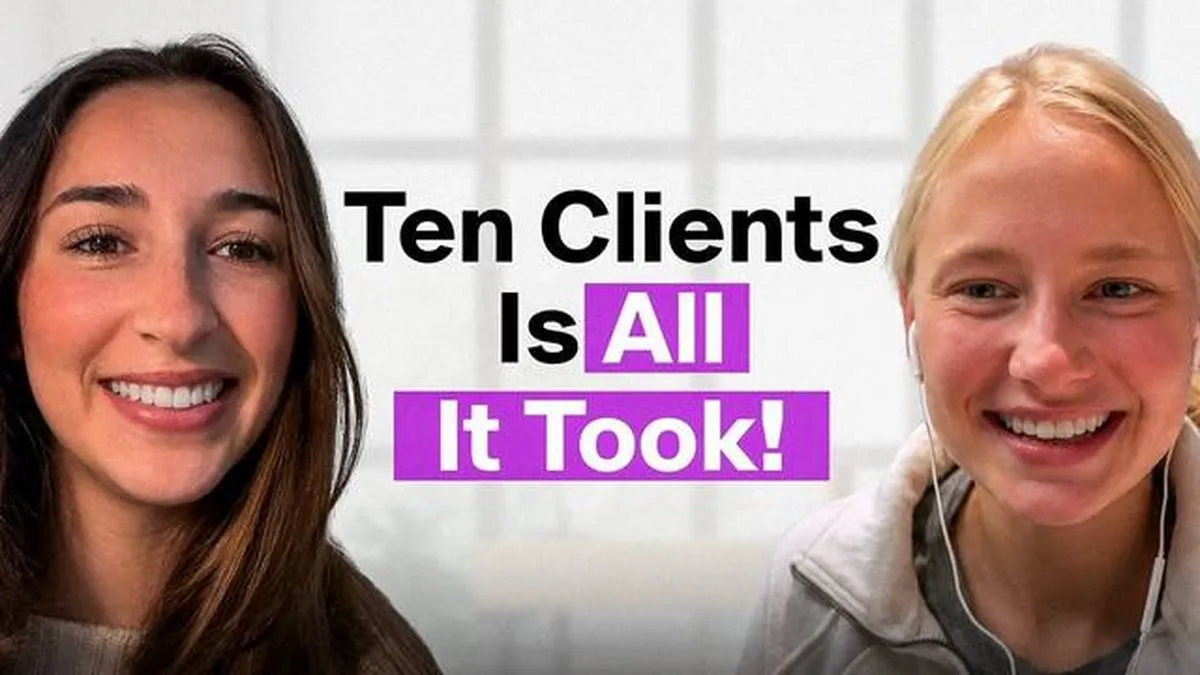
Why Brands Hired This Bilingual UGC Creator for Her Spanish
Key takeaways
- Andrea, a creator in Ecuador, started out thinking every UGC video had to be in English. After her first few deals she noticed brands picked her for her Spanish, and she now films about 90% of her videos in Spanish.
- Language learning and accent apps look for creators who are not native English speakers. Andrea's first paid deal, $50 at the end of her first month, came from an app that helps people improve their English accent.
- Build two portfolios, one in English and one in Spanish, and record every voiceover video twice so one shoot gives you two portfolio pieces.
- Put the word bilingual, both languages and your home country in your bio and portfolio. Brands search for those words, and Andrea's bilingual bio brings her inbound deals.
- Andrea says brands came back to her because she answered fast, delivered before the deadline and asked questions when something was unclear.
Andrea spent her first month of UGC pitching about 80 brands a day from coffee shops in Ecuador. She treated it like a full-time job, around eight hours a day. In her head, all of it had to be in English, because that was where she assumed the work was.
At the end of that month, one brand said yes, for $50. The brand was an app that helps people get a better English accent, and it needed creators who weren't native English speakers.
That was the first sign she had it backwards. As a bilingual UGC creator, her Spanish was the thing brands wanted to pay for.
Andrea lives in Quito, where she told us the minimum wage is $500 a month. Before UGC she painted in watercolor and sewed and made clothes. Her husband brought in most of the money, and she wanted to earn her own.
When UGC showed up on her TikTok, she thought the point was free products. In her words, she thought it would be cool to get gifted collabs, and she didn't know you can actually make it a business. She also doubted UGC would work from where she lived.
I live in a country where, to be honest, I might be the only UGC creator taking it seriously here.
Andrea, 0:00:00
Today about 90% of her videos are in Spanish.
I've sat down on camera with three Spanish speakers: Andrea in Ecuador, Lorena in Miami and Paloma, who was born in Spain. Here is what I told each of them about putting their Spanish to work, and the habits that got international brands to keep rehiring Andrea.
What is a bilingual UGC creator, and why do brands want one?
A bilingual UGC creator makes paid videos for brands in two languages. UGC means user generated content: short videos you film on your phone showing a product in real life, which the brand runs on its own ads, website and pages. Brands want bilingual creators because they sell to people in more than one language, and very few creators can cover both.
Andrea described the demand when she came back on my podcast.
Most of the brands want the content for Latin people living in the US or to reach Latin America, which is a huge market. And niches like language apps are always looking for creators that are not native in English.
Andrea, 0:07:02
Supply is the other half. Most of the market is in English, Andrea said, and so are most of the creators, so far fewer people make UGC in Spanish. I told Lorena the same thing in her Miami apartment: there aren't many Spanish UGC creators out there, which leaves an open ocean for you to come in and land Spanish brands.
Speaking two languages is an edge I don't have. I only speak one.
Do you have to make UGC in English?
You can film most of your UGC in Spanish. Andrea assumed she had to use English, and her first few deals proved her wrong. She learned UGC from English content and felt comfortable speaking it (her husband is British), so she prepared to work fully in English.
When I started I thought I had to do everything in English. I thought there was no campaigns, no opportunities, or maybe not many in Spanish, so I was prepared to do it all in English.
Andrea, 0:05:25
Then her first few deals came in, and the pattern was obvious. She said brands picked her more because she spoke Spanish than for her English. When she sent her portfolio, brands would reply that they saw she spoke Spanish and ask her to make the content in Spanish.
Her communication with brands still happens in English. Pitch in the language the brand writes in, and film in the language its customers speak.
Your accent does matter to some brands, and you should know that going in. Andrea once had a brand love her portfolio and then ask her to do her best American accent. She told them she would try, and they ended up giving her a different brief with no talking at all.
So use it. Paloma is from Spain, and I told her to target startups in Spain and AI companies in Spanish-speaking countries, where she can make the content smoothly in her own accent. In my words to her, the accent really does matter.
Which UGC niches pay bilingual creators?
Start with apps, especially language learning and accent apps. Andrea built most of her business there, and she told us tech brands pay pretty well, better than a lot of other brands from what she has heard.
Her first retainer also came from an English accent app. She worked with them twice, they liked her work, and they asked her to work with them long term. A retainer is when a brand pays you every month for a set number of videos. In our first interview she was also delivering one video a week to BVoice, another accent app.
I had pointed her toward tech UGC, which means making videos for apps and AI platforms. She said it completely changed her life, because she can make content for apps from anywhere in the world. In our first interview she also pointed out that app work means nothing has to be shipped to her.
When I met Lorena, she had spent two months on gifted collabs and hadn't landed a single paid deal. Her niches were skincare, fragrance and tech. I told her the Spanish creators I know who are doing well reverse engineered their niches by asking which brands need someone who speaks two languages:
- Language learning apps. You speak Spanish and English in the same video, helping English speakers learn Spanish or the reverse.
- Tech apps. Tech UGC is blowing up in the Spanish space, and plenty of tech brands want creators who speak both.
- Products you already use. List about 20 products you use every day, like the ones made for your hair, and pitch those brands.
A lot of Spanish brands, sometimes they're business owners and they're like, ah, I need an English creator too. A lot of English brands will be like, oh my gosh, I need a Spanish creator.
Gloria, 0:40:13
If you live outside the US, I wrote a full guide on doing UGC from outside the US that covers what to say when a brand only wants US creators.
Build two portfolios and record every voiceover twice
Make one portfolio in English and one in Spanish, and film every voiceover video in both languages. One shoot then gives you two finished pieces. This was the first item on Lorena's action list.
I do recommend you having an English portfolio and a Spanish portfolio. Two separate portfolios. And what you can do as a creator is you can, every time you create a video, especially the ones that have a voiceover, have a voiceover one in English and one in Spanish. So you get two videos out of one.
Gloria, 0:38:32
Lorena's portfolio put everything under one heading, UGC videos. When I asked which language she preferred to film in, she didn't hesitate.
In this case, in Spanish, in this video, I can explain much better about the fragrances, about how it smells and all of that. In English is more difficult to me to explain all of that.
Lorena, 0:36:56
Lean into that. Put your strongest work in the language you think in, and keep building the other one. Here is how I set up a bilingual portfolio:
- Give each portfolio its own link, like /spanish-portfolio and /english-portfolio on the same site.
- Keep each one fully in its language, then add one small section in the other language, since Spanish brands sometimes need English content and the reverse.
- Label each group of videos by niche, like skincare or tech, so a brand finds its category in the five seconds it spends looking.
- Write a line near the top that says UGC creator and names your niches and both languages.
The rest of my portfolio checklist is in my UGC portfolio tips.
How should a bilingual UGC creator write their bio?
Put the word bilingual, both languages, your niches and your home country right in your bio and on your portfolio. Brands now search for creators with AI tools, typing in things like bilingual Spanish and English creators. If those words aren't in your bio, you don't show up.
Paloma was a social media manager for personal trainers and nutrition clients when she started UGC. Born in Spain to Colombian parents, she moved to Switzerland at 17 and to Australia at 22 to learn English. Now she travels as a digital nomad, so she wasn't sure what location to list. I told her to keep Madrid, Spain.
Put Spain in there because they want to know your accent where you're from, especially for the Spanish creators or the bilingual creators like yourself.
Gloria, 0:04:05
After that she can add "world traveler" and the country she's in right now. Her Instagram bio read as corporate, with capitals, dashes and no personality, and it never said she spoke two languages.
Also make sure that you put bilingual in there as well. Hey, I'm bilingual Spanish and English, right? To show brands that because some brands, some English brands are like, huh, we have a campaign running in Spain, right? They're like, oh, you'd be perfect for it.
Gloria, 0:49:36
I showed Paloma Andrea's profile as the example. Andrea's bio says she's a tech and app UGC creator, adds a little personal touch so it reads human, and says she's bilingual in Spanish and English. That bio is how she gets a lot of her inbound deals. She also has English and Spanish portfolios, and she started with an English Instagram before moving to a Spanish one once more Spanish deals came in.
My full UGC creator bio guide walks through the rest line by line.
How many brands should you pitch a day as a new UGC creator?
Pitch enough that it feels like a job. I gave Andrea a target of about 80 brands a day, and I set Lorena's minimum at 30. Pitching means emailing or messaging brands directly to offer your videos.
I was reaching out to maybe, like you told me, reach out to 80, 80 brands per day or something like that. And I took that very seriously and I did, I did it.
Andrea, 0:08:08
She made it fun on purpose, pitching from a coffee shop and hitting her number every day. Here's what she said that first stretch produced.
I think I closed one deal for $50 in my first month. And then I made 5K the month after.
Andrea, 0:09:09
In an earlier interview, Andrea told us she had pitched about 70 brands on Instagram the other day and got a very good deal from it, so she planned to do it again (0:30:20 in that interview).
Lorena had sent 47 pitches in two months when we met, and the pitch itself needed a rewrite. Once we fixed it, I gave her 30 brands a day and told her to get on three or more platforms, like Bento and SideShift, and pitch on all of them.
Here is how I explained the math to Lorena. About 10% of a UGC business comes from pitching and 90% from referrals, word of mouth and repeat clients, but as a beginner that 10% carries everything until the rest builds up. Andrea got there. She said she makes at least 5K a month basically without pitching now, mostly from retainers and inbound deals.
How do you get UGC brands to hire you again?
Be the creator who is easy to work with. Andrea says international brands keep coming back because she's reliable. She answers messages fast, sends videos before the deadline or on it and never after, and asks questions whenever she doesn't understand something. Before she suggests anything, she listens to what the brand needs.
Some of the CEOs she works with have told her this is rare.
This is not normal for me, I don't have these kind of relationships with creators, my relationship with creators literally lasts five days usually.
Andrea, quoting brand CEOs, 0:13:34
She was honest that this took adjusting to. In Latin America, she said, the culture around professionalism is different, and working with American and international brands taught her that being late all the time won't be accepted.
Her best proof came from a mistake, which she told me about in our first interview. On one of her first deals, which later turned into a retainer, she misread the brief and sent videos they hadn't asked for. She told them not to worry and sent what they wanted within a couple of hours, five videos in total. The brand liked all of them and paid her for every one.
I made a mistake, but I fixed it. I think that's what brands like, that you are easy to work with, they can trust you and you're going to deliver fast and good.
Andrea, 0:32:21 (first interview)
Here's her daily routine, as she described it in that same interview:
- Answer brand emails first, as fast as possible
- Write every task in a physical notebook
- Batch film client videos in one day when she can
- Film, edit and send a project in one go, and send it early
- Practice on camera every day, even when there's no client video
When she gets creative freedom on a language app video, she studies TikTok and Instagram for the formats and hooks that are working, sends the brand her ideas and a script, and films once they accept it. A hook is the first few seconds of a video that stop someone scrolling. For her own setup she uses good light and a small DJI mini mic, and she said sound matters most.
I go deeper on turning one-off clients into monthly work in how to get a UGC retainer.
What being a Spanish UGC creator turned into for Andrea
Seven months after starting, Andrea told me on the podcast she thought she'd reach $10,000 that month, mostly from UGC retainers plus some one-on-one mentorship she'd started giving Spanish speakers. On one of the last days of the month, she texted me her numbers. She had done it.
Every one of her clients now pays her more than $1,000, she said. She travels and works from wherever she is, and she's more active on her Spanish Instagram than her English one. People in Latin America message her every day asking how to start, because she was one of the first people talking about tech UGC in Spanish.
The thing she was sure would hold her back became the reason brands chose her. If you speak two languages, start building both portfolios this week.
Gloria
Disclaimer: The results in this post are what Andrea, Lorena and Paloma told us about their own work. They aren't typical or promised. What you earn from UGC depends on your own effort, skill, niche and market.
Frequently asked questions
Can I do UGC if English is not my first language?
Yes. Andrea's first language is Spanish, and her first paid deal came from an app that needed non-native English speakers. She told us brands ended up picking her more for her Spanish than for her English, and today about 90% of her videos are in Spanish while her emails with brands stay in English.
Is there demand for UGC in Spanish?
Andrea says most brands that hire her want content for Latin people living in the US or to reach Latin America, and that far fewer creators work in Spanish than in English. Gloria tells Spanish speakers that tech UGC is growing fast in the Spanish space and that language learning apps want creators who speak both languages.
Should a bilingual UGC creator have two portfolios?
Gloria recommends it: one portfolio fully in English and one fully in Spanish, each linked in your Instagram bio. Each one can carry a small section in the other language, since Spanish brands sometimes need English content and English brands sometimes need Spanish content.
What should a bilingual UGC creator put in their bio?
Your niches, the words bilingual UGC creator, and both languages, such as bilingual Spanish and English. Brands now search for creators with AI tools, typing in things like bilingual Spanish and English creators, so a bio without those words won't show up.
About the author. Gloria Stonelake is co-founder of UGC World and Head of Creator Talent. She took home over $150K in one year from UGC, then built the agency brands pay to staff their campaigns with trained creators. Meet the UGC World team.
UGC World is a personal and business finance education and training company. Results described here are the experiences of the named creators and are not typical. Success depends on implementation and effort. We do not make claims about what you should expect to make.

