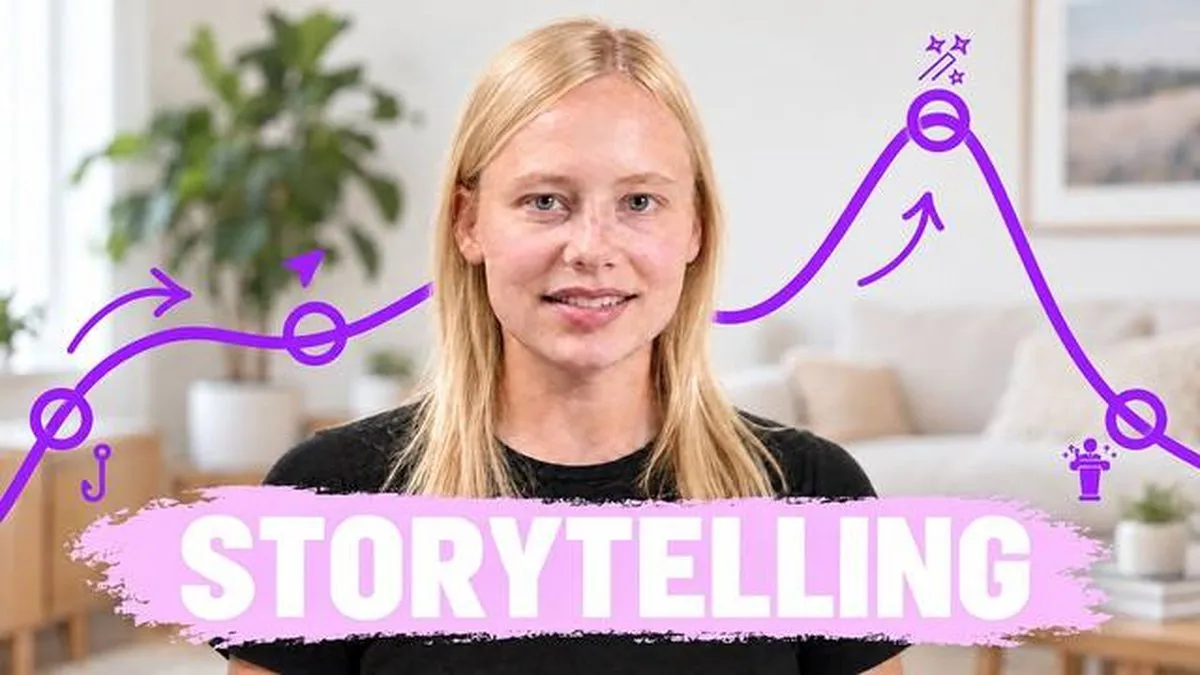
UGC Storytelling: How I Turn Any Product Into a Story
Key takeaways
- UGC storytelling puts a product inside a short, relatable story, so the viewer sees their own problem first and watches the product solve it.
- Mannie Williams builds every story on four beats after the hook: problem, emotion, solution, and where to go next.
- To find a story for any product, combine your own experience of the problem with the life of the person who would buy it.
- Research the brand before writing: a creatine brand's 30-year, bootstrapped founder story became the angle for one of Mannie's videos.
- Plan a shot for every action you narrate, and treat the first three seconds as the part that decides whether anyone hears the rest.
One morning in Los Angeles I woke up at 6 a.m. to a negative balance in my bank account and figured I was doing Instacart that day.
I teach UGC storytelling at UGC World now. Back then I was a guy from Redford, Michigan, outside Detroit, who had moved to LA on October 7th, 2019. I'd spent years at home making YouTube videos, short films, music videos and promos, and I'd hit a glass ceiling. A couple of months after I landed, COVID hit.
Every time I typed "how can I make money off this computer" into Google, it offered me surveys: fifteen minutes of my time for 14 cents.
The book I was reading, The 4-Hour Workweek, said to hire someone for small jobs, even for fifty bucks. So I went looking for one of those small jobs. A week later I had a list of contacts, and I emailed everybody on it, straight to the CEOs.
I actually emailed CEOs. I wasn't trying to go to the middlemen, the people that was all like, oh, we'll check. I'm like, I don't got time for that. I need a job today.
Mannie Williams, UGC Games, 4:37:03
One person wrote back. His name was Thomas Ma, and he was from an agency. When I offered to pull up with my whole camera setup, he said all he needed was me, recording myself playing a mobile game.
That reaction video took about ten minutes. A day later I had $50 and a request for another one, then two more. I edited each one on my phone in CapCut, and before long I had $200.
After asking a lot of questions, I found out it was called UGC. Since then I have made over 1,000 videos and photos and worked with more than 120 brands, and Feedspot ranked me in the top 11 male UGC creators. When I started, I had about 250 followers.
In the UGC Games, I stopped the story right there.
See, I got your attention and held it down for that long. See? That's storytelling, baby.
Mannie Williams, UGC Games, 4:39:55
The rest of this is how I teach creators to do the same thing with a product.
What is UGC storytelling?
UGC storytelling is telling a short, relatable story with a product in the middle of it. The viewer recognizes their own problem first, then watches the product change the situation. UGC (user generated content) means short videos regular people film on their phones that brands run as ads or posts.
People buy from someone they relate to. In the UGC Games I held up a bottle and said, you should buy this. You had just met me and the bottle hadn't earned your trust, so you didn't care.
Then I told them what was in it: magnesium. Going to bed late, I had been waking up tired with a foggy head, and a friend told me he took it. For the first few days I felt nothing.
By the sixth day I went to bed around midnight, woke at 6 a.m. and felt like I had slept nine hours. Same bottle, and now the room had a reason to care.
The UGC story structure I use: problem, emotion, solution, where to go next
After the hook, every story I write has four beats: the problem, the emotion, the solution and where to go next. The product shows up as the solution, and the creator walks the viewer from one beat to the next.
You're talking about a product. You are the bridge. You expose the problem. You go into the emotion. What are they struggling with? Then you go into the solution.
Mannie Williams, UGC Games, 4:56:16
Here is the electrolyte powder story I built live in the UGC Games:
-
Problem: I wasn't drinking water, because water is boring next to coconut water, pop and Mountain Dew.
-
Emotion: Trying to make a lifestyle change was a struggle, and it annoyed me because I knew those drinks aren't good for me long term.
-
Solution: Lemon juice helped a little, then somebody put me on a blue raspberry electrolyte powder and I started drinking a lot more water.
-
Where to go next: It tastes good, here is where I got it, and if you're curious, look it up for yourself.
That last line is my personal style of call to action. I hate when people push things on me, so I lead people to the product and let them decide. Pick the call to action that sounds like you.
My UGC script template turns this into five fill-in-the-blank parts.
How do you tell a story about a product you barely use?
Pull from two places: your own experience of the problem, and the life of the person who would buy the product. Then ask what that person wants deep down.
Gloria asked me on her show how a beginner would storytell a pair of blue light glasses, so I did it on the spot with sunglasses. My own experience came first. You walk outside, it's bright, you can't find your sunglasses, and every friend around you has theirs on.
Next came the person I'm talking to. Sunglasses protect your eyes at the beach, and they make you look cool.
So the story went like this. I'm driving with my friend, the sun blinds me, and he's sitting there in his shades, unbothered. Low-key, I'm jealous.
After borrowing his pair, I look in the mirror and feel cool. He tells me where he got them, I check the prices at home and buy a pair, and now I'm driving through the neighborhood fitting in with my friends.
The desire under that story is fitting in.
Gloria added a point about going deeper than a label. Instead of "I'm anxious," say "I feel shaky every time I go out and talk to people."
Any object works. In the UGC Games, Jen Winkler built a story from a coffee mug: waking up grumpy, filling it with her favorite coffee, and remembering her Portuguese grandparents and her grandfather's deep voice. Gloria told her that building a story from a mug is a superpower.
Why UGC scripts feel stiff, and where the feeling comes from
A script feels stiff when it has a framework and no feeling in it. The feeling comes from paying attention to people, starting with yourself.
But then, you know, you have frameworks, the logic, the solution. Great. It's just lines, but there's no color. So you kind of want to find a way to actually put both of them together.
Mannie Williams, talking with Gloria, 17:12
Picture a coloring book. Emotions, intuition and feelings are the colors, and a framework is the lines. Colors with no lines get messy, and lines with no color are why so many videos feel stiff and choppy.
To find the color, I ask questions, like asking friends why they buy sunglasses. The weird quirks are worth noting, because those are the things people don't want to talk about.
Being relatable works like being the kid who raises his hand in class because nobody else will. Everyone who was scared to ask the same question tunes in. Talk about the thing people feel and don't say out loud.
How I research a brand's real story before I write a word
Start with research on the brand, its audience and what is happening that month. I use ChatGPT to help with the research so I know who will watch the video, and I check for a season or holiday to work in.
A creatine brand I looked into had an Instagram full of product shots. Digging further, I found out it was their 30th year, with no anniversary content and no story about the founder.
The founder had no endorsements and bootstrapped the company until it became successful. He did his own scientific research, and his product was full creatine, where some supplement brands sell a blend that's around 70% creatine.
With so many supplement brands out there, that story was what made them stand out. Before that video I had never used the product. Trying it on camera (it tastes like regular creatine, no flavor), I built the video around who the founder was and why the product was different.
Match a shot to every action in the story
Write the story first, then plan a visual for every action in it. If the narration says something happened, the viewer should see it happen.
My process, in order:
- Research the brand, the audience and the month
- Write a rough story with a character, their problem and how it resolves
- Pick the hook, whether visual, curiosity or the person talking
- List the shots, one for every action in the script
- Film, then edit in B-roll, graphics, music and sound effects
- Show a friend, get feedback, make changes or don't, and post
Say the character is Susie, and Susie needs her coffee. Thirty seconds of her talking in one frame is boring.
If she talks about I have to run to my car, I need to put a shot of her running the car. I need to fill in visuals to all these actions that she talks about so someone will be engaged because now they feel like they're part of it.
Mannie Williams, talking with Gloria, 28:06
I build videos in layers: the basic video of you talking, then B-roll, then graphics, then sound effects and music on top. People sleep on sound effects. With your eyes and ears both engaged, you start anticipating what comes next.
The videos that do best are the visual ones, because someone who speaks a different language can still follow them. My Halloween video works this way. Bitter coffee haunts me, chasing me through the whole space with jump scares, until I run to the store, find a coffee I like and make my own cup. My framework for it was simple: dude is haunted by coffee, runs, finds the right coffee, and he's saved.
Cutaways are my favorite tool. You narrate, cut to a quick scene showing what you mean, then come right back, and every cutaway reinforces your message.
By the end of the video if I reinforce the message five times I probably changed your belief system in some sort of way shape or form.
Mannie Williams, talking with Gloria, 43:01
For the filming side, how to film UGC videos on your phone covers the shot list and setup, and how to edit UGC videos in CapCut covers the layers.
Why do the first three seconds decide whether your story gets watched?
The hook (the opening line or image that stops the scroll) decides whether anyone sees the rest. You can make an amazing 60-second video, and if the first two or three seconds don't pull people in, they skip it and the story never gets heard.
The hook is key. The first three seconds of everything is most important.
Mannie Williams, UGC Games, 5:13:04
A hook works because people want to know how the story ends. You can hook with a visual, with shock value, or with curiosity, like "I don't know who needs to hear this, but if you do X, Y and Z, here's something you should think about."
Here is how one of my own videos opens, for a water bottle:
So I was always drinking three cups of coffee a day because I was always tired. Why was I tired? Because I was snoring and breathing wrong before I went to bed. How did I find that out? Surprisingly, this water bottle, specifically this nozzle right here. Wait, a water bottle? Yeah, it's crazy, right?
Mannie Williams, UGC Games, 5:31:18
The problem comes first, then a question you can't answer yet, and the product shows up as the surprise answer.
I go deeper on openings in how I write UGC hooks.
The UGC storytelling mistakes I see most
The biggest mistake is an unclear message. Scrap the layers and ask what one message the viewer should walk away with.
Treat a story like a college paper: here's the title, here's the body, and the moral of the story is this.
Check your script against this list:
-
Too many details: go from point A to point B, and keep a detail only if it moves the story forward.
-
Features instead of feelings: "organic" and "clean energy" are vague, while "foggy mind sucks" and "this doesn't make me bloated" are things people feel.
-
Sounding like an ad: viewers know the game, and if it feels like a sales pitch, they skip.
-
No energy: I use three E's, which are education, entertainment and enthusiasm.
-
Promoting what you don't believe in: early on I made a video for an ab product that didn't stick on well, because I needed the $35, and I didn't like that feeling. Now if something doesn't work or doesn't fit my values, I say no.
How to practice UGC storytelling in 30 days
Tell a story every day. Look in the mirror or at your phone and tell the story of your day yesterday in about two minutes, and after 30 days, summarizing a moment out loud comes naturally.
Pick one moment instead of your whole life. In the UGC Games I told a high school crush story using three moments: the shy feeling before talking to her, the word vomit and the walk home feeling stupid, then trying again and getting the yes. Each of those works as its own part on TikTok.
While you draft, keep asking "and then what happened?" We all want to know what happens next, and that question is what keeps people watching.
Then test the story with a cliffhanger. Once I told my eighth grade crush story and stopped right at the day she came over to my house. Everyone asked what happened next, and that's how I knew the story was good.
Then practice on products. Grab anything near you, like a candle, a mug or a trash bag, and film a 20 to 30 second video with a hook, the problem, the emotion, the product as the solution and a call to action.
If being on camera is what stops you, talk about your day for one minute, five days in a row, without planning it. These acting drills for sounding natural on camera help after that.
Five years after that first $50 video, I met Thomas Ma in person, and he told me I had been one of their best creators.
That was news to me. I was just out there making videos.
The earnings and results in this post are Mannie Williams' own experience, shared in his own words. They are not a prediction of what any creator will earn.
Frequently asked questions
What is UGC storytelling?
UGC storytelling is telling a short, relatable story with a product at its center. The viewer recognizes the problem and the feeling, then watches the product change the situation. Mannie Williams frames the creator as the bridge between the viewer's problem and the product.
What is the best storytelling structure for UGC ads?
Mannie Williams uses hook, problem, emotion, solution and call to action. The hook stops the scroll, the problem and emotion make the viewer feel seen, the solution brings in the product, and the call to action tells them where to go next.
How do I tell a story about a product I have never used?
Start with your own experience of the problem the product solves, then think about the person who would buy it and what they want. Research the brand too. Mannie built a creatine video around the founder's story after finding it through his own research.
How long should a UGC storytelling video be?
For practice, Mannie had creators in the UGC Games film a 20 to 30 second video with a hook, a problem, the emotion, the product as the solution and a call to action. Keep the message tight and cut details that do not move the story forward.
How can I get better at storytelling on camera?
Mannie's 30-day drill is to look in the mirror or at your phone and tell the story of your day in about two minutes, every day. After a month you know how to summarize a day, pick the interesting moment and say it out loud.
About the author. Mannie Williams has made 900+ videos for brands including Red Bull and CBS and coaches storytelling at UGC World. Meet the UGC World team.
UGC World is a personal and business finance education and training company. Results described here are the experiences of the named creators and are not typical. Success depends on implementation and effort. We do not make claims about what you should expect to make.

